Style Imitating Art…
Welcome to Style Imitating Art which comes from Salazar, Shelbee, and me. You can think of this series as fashion meets art museum! SIA challenges people to find inspiration in different art works, create looks based upon that art work, and share them with the curator for that piece. Shelbee is this week’s curator with two amazing paintings. They have the same name but are completely different! I hope you enjoy this post, the information, and my interpretation.
How it works…
Every other Monday one of us selects an inspiration piece of art and posts the image on their blog. We then invite others to interpret that art work through their style. The following Monday, we share our outfits. The curator shares submissions the following Wednesday on her blog. Shelbee chose this week’s art work for this round of Style Imitating Art. If you’d like, you can read why she chose it here. Please send your photo Shelbee by Tuesday, May 6th, 2025 by 10 pm EST. Style Imitating Art is an interesting way to inspire your outfits. You can see a few of my looks here, here, here and here.

About the artist…
Diego Rivera was born in Guanajuato, Mexico on December 8, 1886. His parents, María del Pilar Barrientos and Diego Rivera Acosta were well to do. His twin brother, Carlos, died at the age of two. Rivera’s mother may have had converso ancestry which meant her Spanish ancestors were forced to convert from Judaism to Catholicism in the 15th and 16th centuries. Even though he was an atheist, Rivera wrote “My Jewishness is the dominant element in my life”, despite never being raised practicing any Jewish faith, Rivera felt that his Jewish ancestry informed his art and gave him ‘sympathy with the downtrodden masses (source).’” He was, additionally, of Spanish, Amerindian, African, Italian, Jewish, Russian, and Portuguese descent.
His parents encouraged his artistic endeavors from an early age. At the age of three, young Diego began drawing on the walls of the house. His parents put in chalkboards and hung canvas on the walls so he could continue to draw. Rivera’s art education began at age ten when he studied at the Academy of San Carlos in Mexico City. Teodoro A. Dehesa Méndez, the governor of the State of Veracruz, sponsored Rivera’s study in Europe where he first went to Madrid, Spain to study with Eduardo Chicharro. He next went to Paris which was the place to be for an artist. He palled around with Amedeo Modigliani, Ilya Ehrenburg, Chaim Soutine, and Jeanne Hébuterne as well as gallery owner, Léopold Zborowski.
Even more…
For four years, from 1913 to 1917, Rivera painted in the style known as Cubism. Eventually, he began to experiment with Post-Impressionism, especially inspired by Paul Cézanne’s paintings. His forms became simpler and involved large portions of vivid colors. Soon, Rivera was displaying at several exhibitions. In 1920, Rivera returned to Mexico after the Mexican ambassador to France, Alberto J. Pani, urged him to do so. He took the scenic route, though, and studied art in Italy which included Renaissance frescoes. In 1921, José Clemente Orozco, Minister of Education, planned a mural program. This involved government sponsored Mexican murals. Artists such as José Clemente Orozco, David Alfaro Siqueiros, and Rufino Tamayo as well as French artist, Jean Charlot, were also involved. In January, 1922, Rivera began his first mural, Creation, at the National Preparatory School in Mexico City. Other murals soon followed but were painted only in fresco. Fresco is when you paint with watercolors on fresh plaster. The color becomes a part of the actual plaster as it dries. Rivera’s murals reflect Mexican society and present large, simple characters as well as bold colors. The Aztec influence can be seen in murals at the Secretariat of Public Education in Mexico City. These murals were begun in September 1922 and finished in 1928. At least one hundred twenty -four frescoes were completed. Between 192 2and 1953, Rivera painted murals in other places, including Chapingo, Cuernavaca, San Francisco, Detroit, and New York City. Sometime after 1931, he painted 27 murals known as the Detroit Industry Murals.
Still more…
In 1922, Rivera joined the Mexican Communist Party, including its Central Committee. His murals reflected those beliefs as well as telling stories of the worker’s plight. He included the hammer and sickle as well as a woman holding an ear of corn in each hand. The hammer and sickle, often associated with Communism, reflected the working peasants (farmers) and the working class (industry). The ears of corn evoke the Aztec goddess of maize. This particular mural was created in the chapel of the Chapingo Autonomous University of Agriculture. The corpses of Emiliano Zapata and Otilio Montano, revolutionary heroes, appear in their graves, symbolically fertilizing the maize field above them. Rivera often included major players in the Communist party in Russia in his murals. In 1927, Rivera was invited to Moscow to celebrate the tenth anniversary of the October Revolution. He was commissioned to paint a mural for the Red Army club but was ordered to leave the country in 1928. He believed this was because Soviet artists resented him. Upon his return to Mexico in 1929, Rivera was kicked out of the Communist party because of a multitude of suspicions.
A skosh more…
In 1926, Rivera had become a member of the Ancient Mystical Order Rosae Crucis (AMORC), an occult organization founded by Harvey Spencer Lewis. Rivera was a founder of AMORC’s Mexico City lodge which was called Quetzalcoatl after an ancient indigenous god. Rivera painted an image of the god for the local temple. Many years later, in 1954, Rivera asked to be readmitted to the Mexican Communist Party. To do so, he had to justify why he was a part of the AMORC and its activities. The Mexican Communist Party considered AMORC similar to Freemasonry which was excluded from the Communist party. Rivera claimed to be a spy who infiltrated a “Yankee” organization!
A bit more…
Between 1932 and 1933, Rivera was commissioned to paint 27 fresco panels, Detroit Industry, at the Detroit Institute of Arts. A portion of the commission was paid by Edsel Ford. During the McCarthy Era, the Institute placed a sign in the courtyard basically saying the art was good, but Rivera’s politics were “detestable.” In 1933, Rivera began work on a commission for John D. Rockefeller for the Rockefeller Center in NYC. This mural, Man at the Crossroads, included a portrait of Vladimir Lenin. Rivera was asked to remove Lenin from the scene, maybe just paint a different person, but he refused. The management company of the Center ordered what had been completed to be destroyed. Rivera was also ordered to leave the US. One of his assistants took a few photographs which aided Rivera in recreating the mural in other places. This situation also resulted in a cancellation of a commission for Rivera to paint a mural for the Chicago’s World Fair. Rivera had been paid in full for the NYC mural and said he would use the remaining money to paint Man at the Crossroads repeatedly until the money ran out! There have been some who say the piece was painted over, but I also read that it was actually destroyed with wheelbarrows removing the plaster and dust. Rivera would return to the US to paint more frescoes in his later years.
Beliefs…
Rivera’s atheism also created problems for commissions. He painted Dreams of a Sundya in the Alameda which showed Ignacio Ramírez holding a sign that read, “God does not exist.” Rivera refused to remove those words. He definitely stood up for his beliefs; the painting was not displayed for nine years. Rivera eventually agreed to remove that inscription. He said,
“To affirm ‘God does not exist’, I do not have to hide behind Don Ignacio Ramírez; I am an atheist and I consider religions to be a form of collective neurosis.”
Rivera also claimed to be a cannibal. He especially liked women’s brains in vinaigrette. Not very many people believe this to be true. Rivera wrote, and I paraphrase, when mankind evolves far enough eating human flesh will be OK because man will have “thrown off all of his superstitions and irrational taboos.”
Marriages…
Rivera was married four times. He met his first wife, Angelina Beloff, in Paris and married her in 1911. This union produced Rivera’s only son, Diego, who died as a toddler. He had an affair with Maria Vorobieff-Stebelska, the mother of his illegitimate daughter, Marika Rivera. He divorced Beloff and returned to Mexico where he married Guadalupe Marin in June 1922. They had two daughters, Ruth and Guadalupe. During this marriage, Rivera met Frida Kahlo who was still a student. The two began a passionate affair. He was 42; Kahlo was 22. Rivera divorced Marin and married Kahlo in 1929. The two divorced in 1939 because neither could stay faithful. In December, 1940, however, the two remarried and continued their tumultuous relationship until her death in 1954. Rivera then married his fourth wife, Emma Hurtado, his agent, in 1955.
Finally…
As of 2018, Rivera’s 1931 painting, The Rivals, sold for $9.76 million which is the record for the highest price at auction for a Latin American artist. The Mexican government has declared Rivera’s works as monumentos historicos. Rivera’s frescoes established the mural movement in Mexican and international art. In 1960, My Life, My Art: An Autobiography by Rivera with Gladys March was published posthumously. March began interviewing him in 1944 for a newspaper article. She spent “several months each year with Rivera, eventually filling 2,000 pages with his recollections and interpretations of his art and life.” March then used this material to “write” the autobiography in the first person. Diego Rivero died on November 24, 1957 at the age of 70 of congestive heart failure. He is buried at the Panteón de Dolores in Mexico City. You can read his obituary here.
The art work…
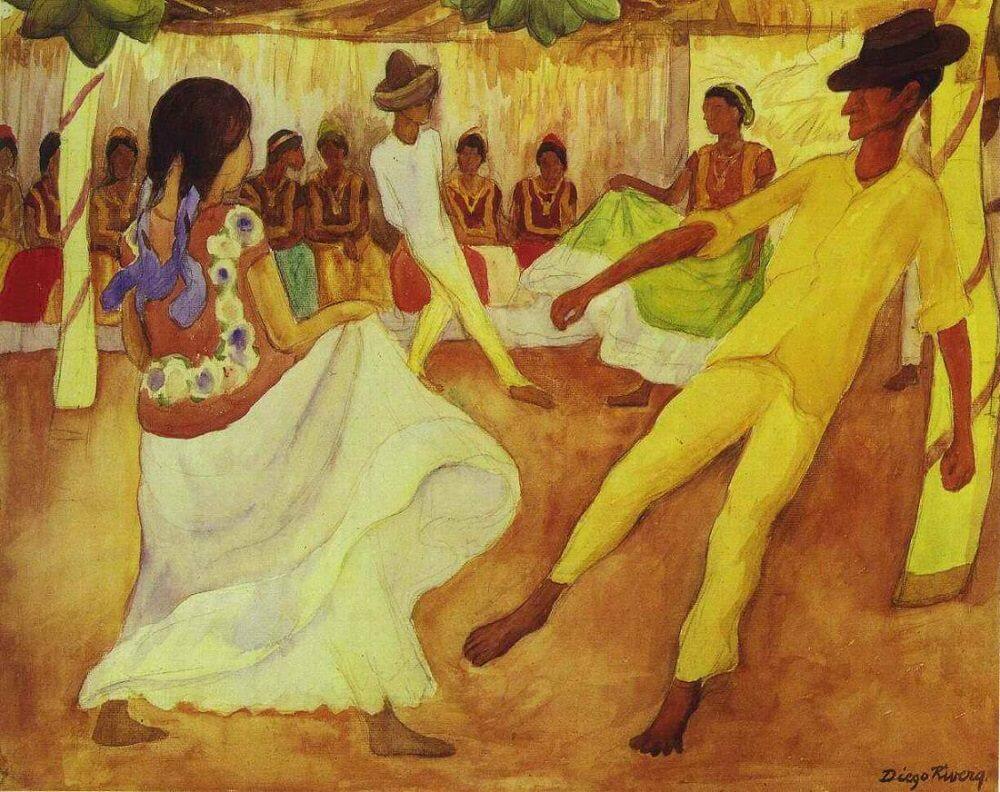
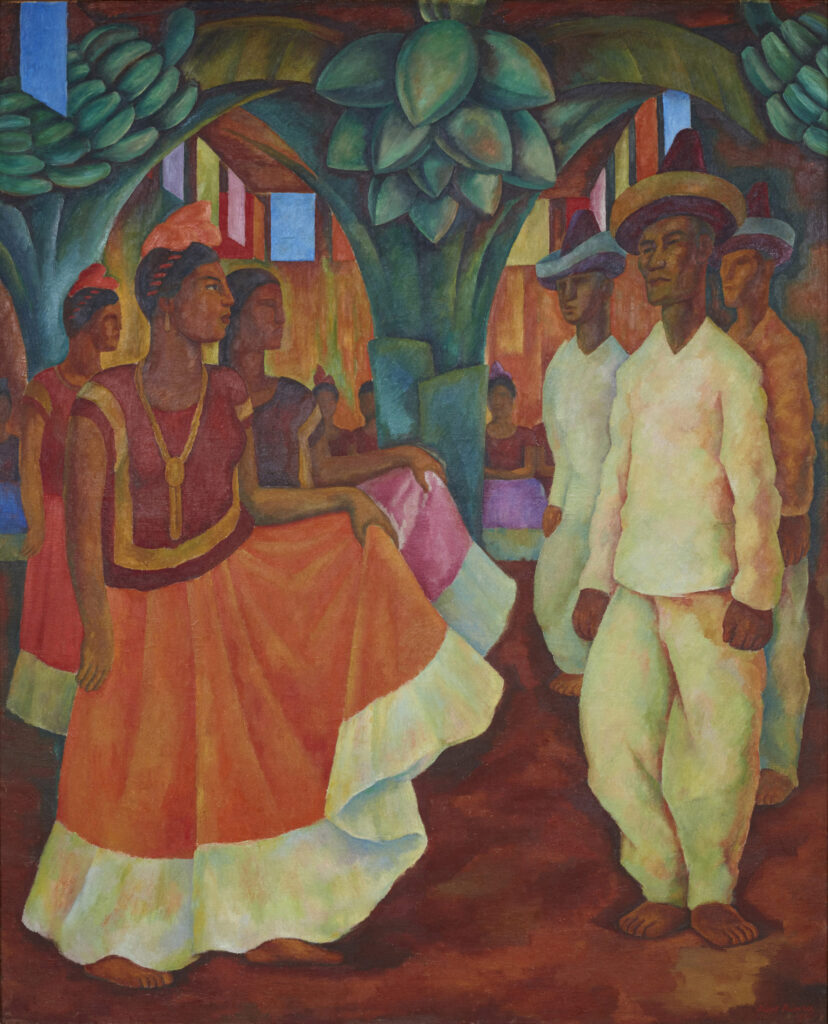
The top art work is currently stored in the Los Angeles Museum of Art. But, I’m not 100% sure of that. I tried searching that museum’s website and came up empty handed. Let’s just go with what the Diego Rivera website says. The painting measures 18 15/16 x 23 7/8 in. (48.1 x 60.64 cm) and was painted in 1935. It’s part of the Clarissa and Edgar Bronfman Jr. Collection. Strangely, I googled that collection and came up with this! The article is behind a paywall, but did you notice the painting she’s standing in front of? Now, I’m really confuzzled! Try as I might, I couldn’t get much more information than this. I’m betting Shelbee will have some!
My interpretation…
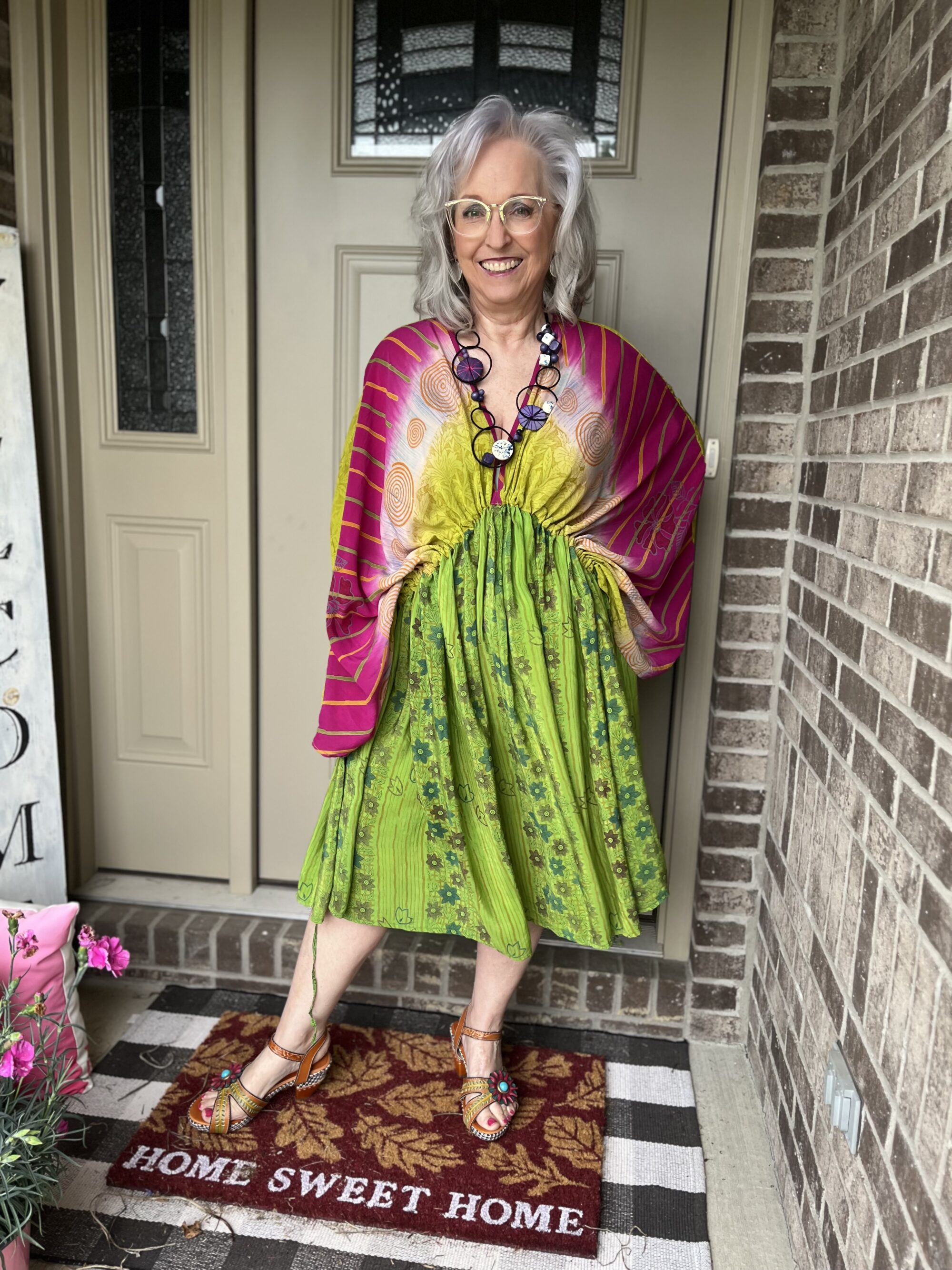
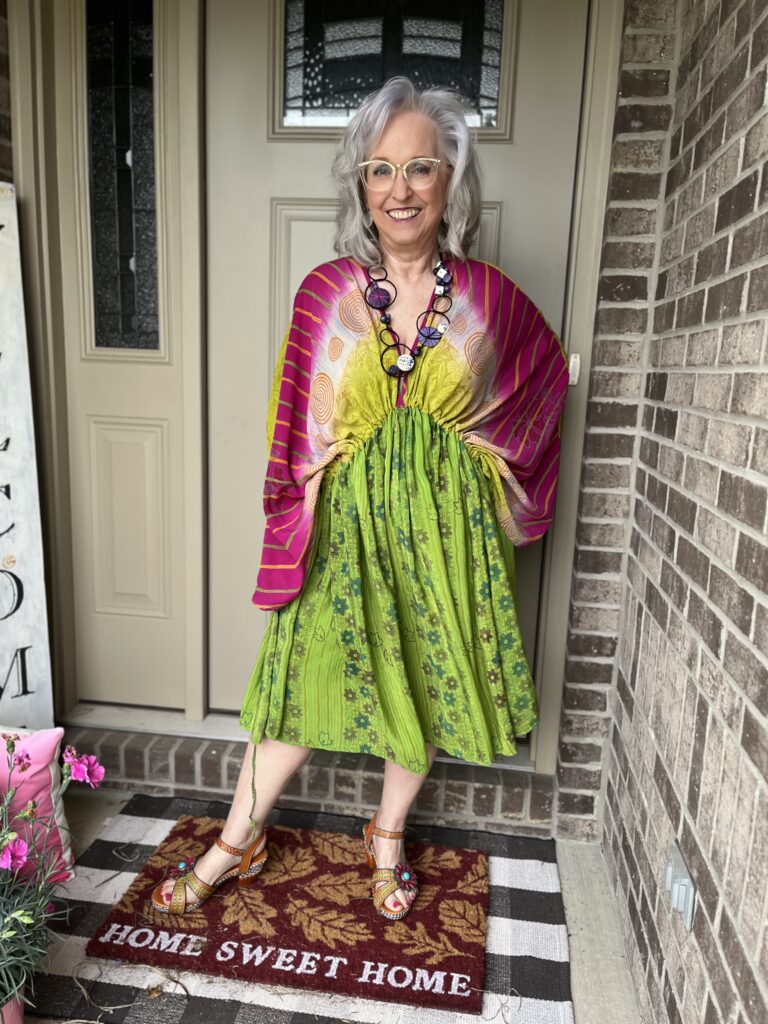
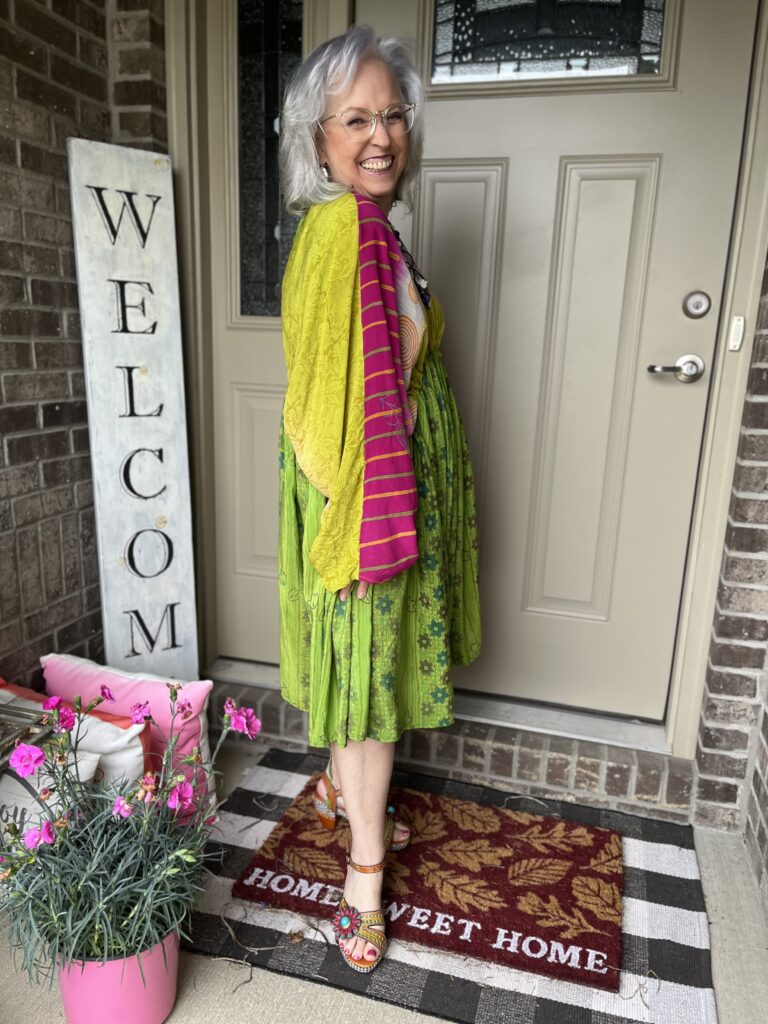
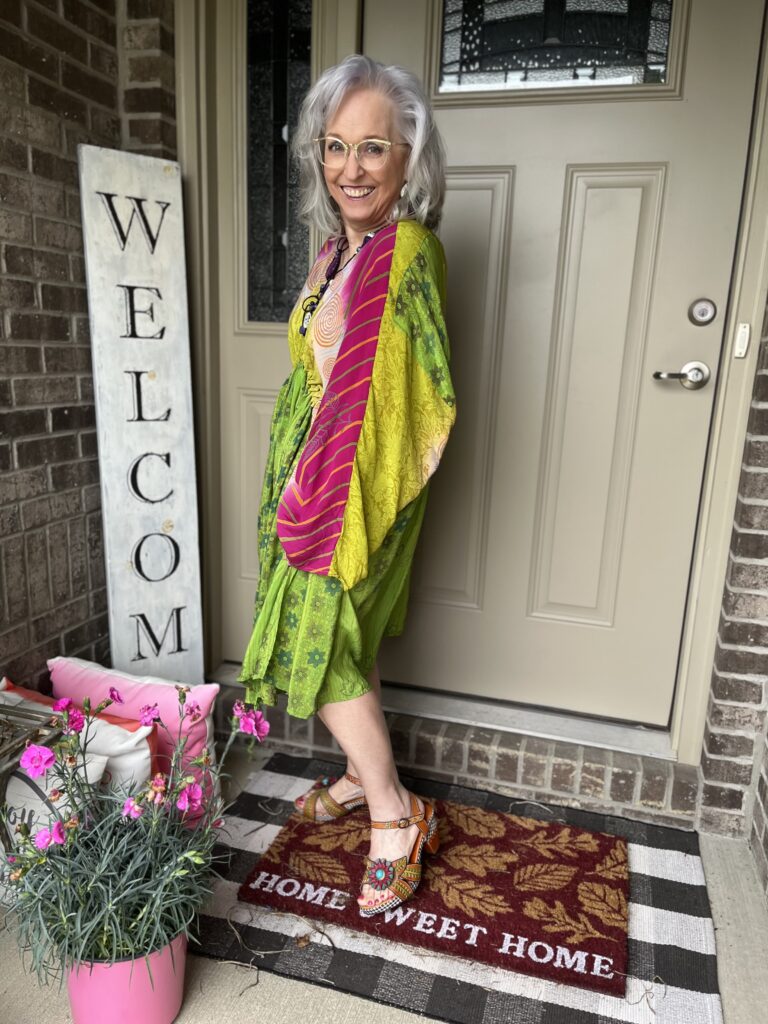
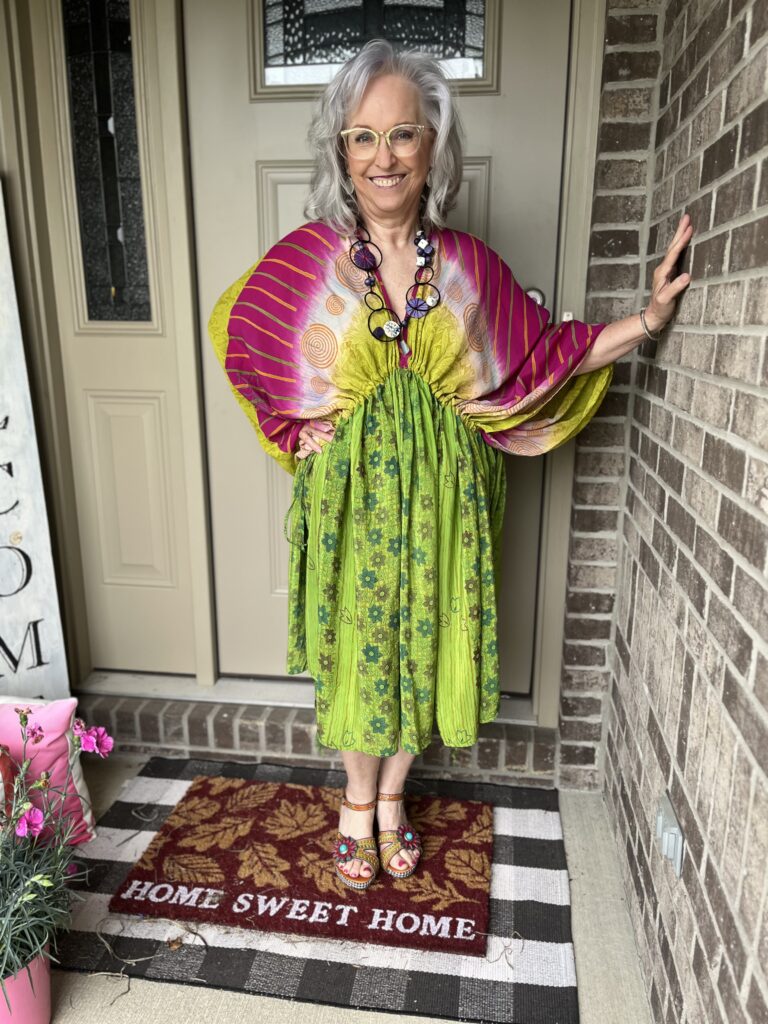
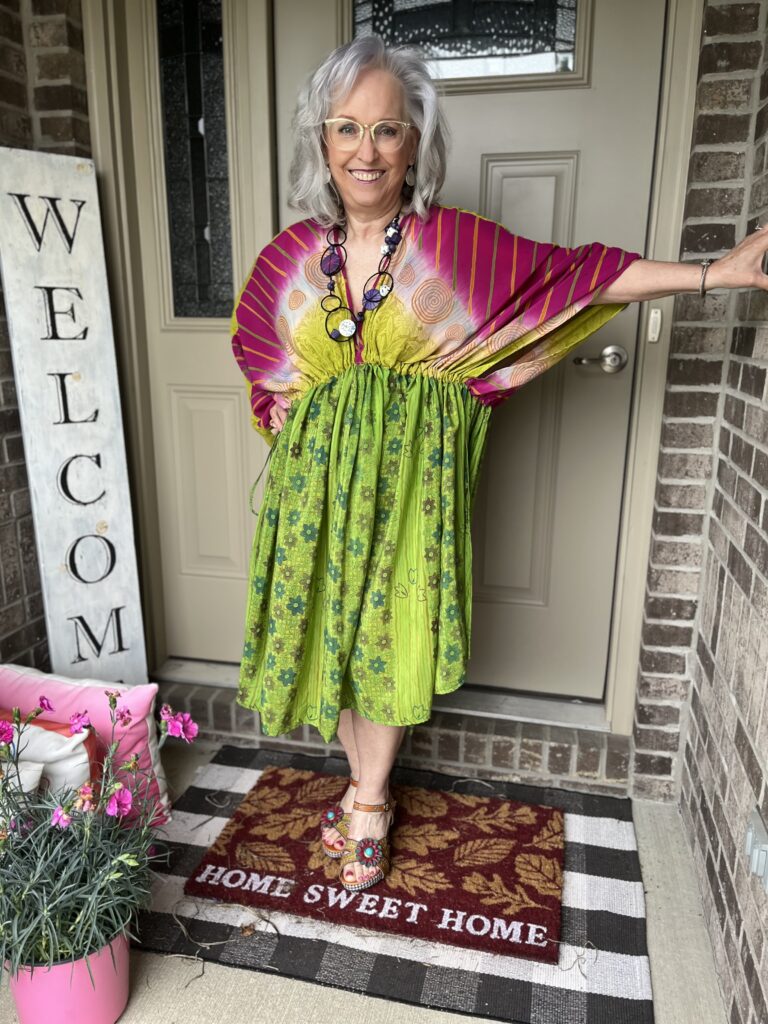
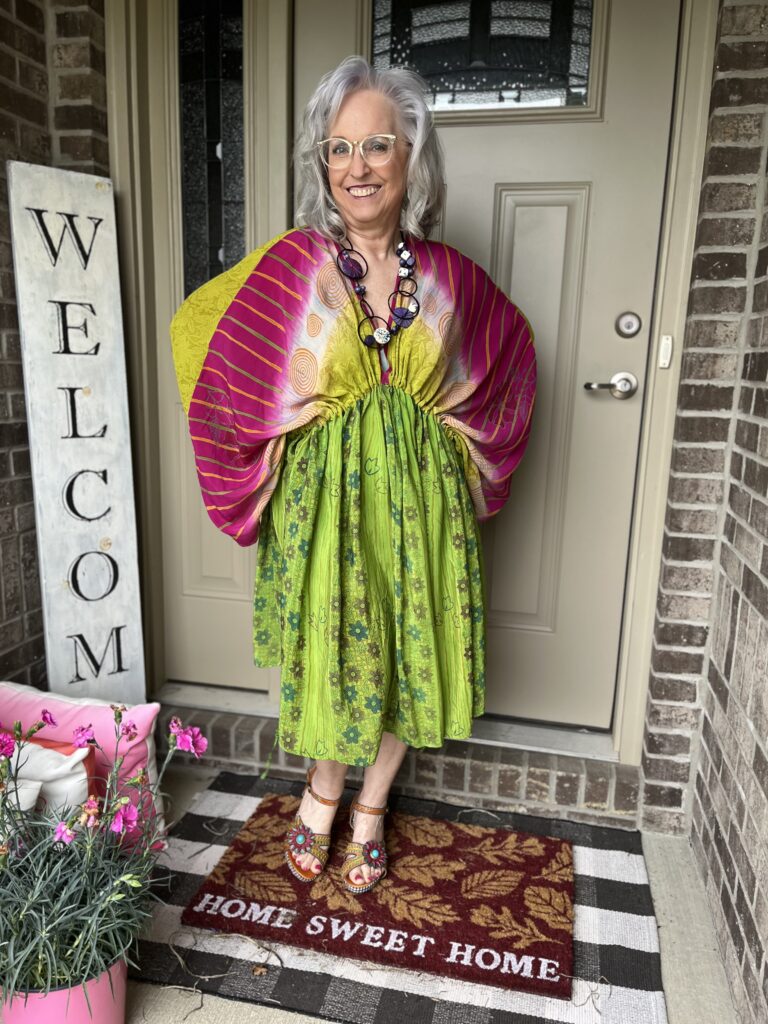
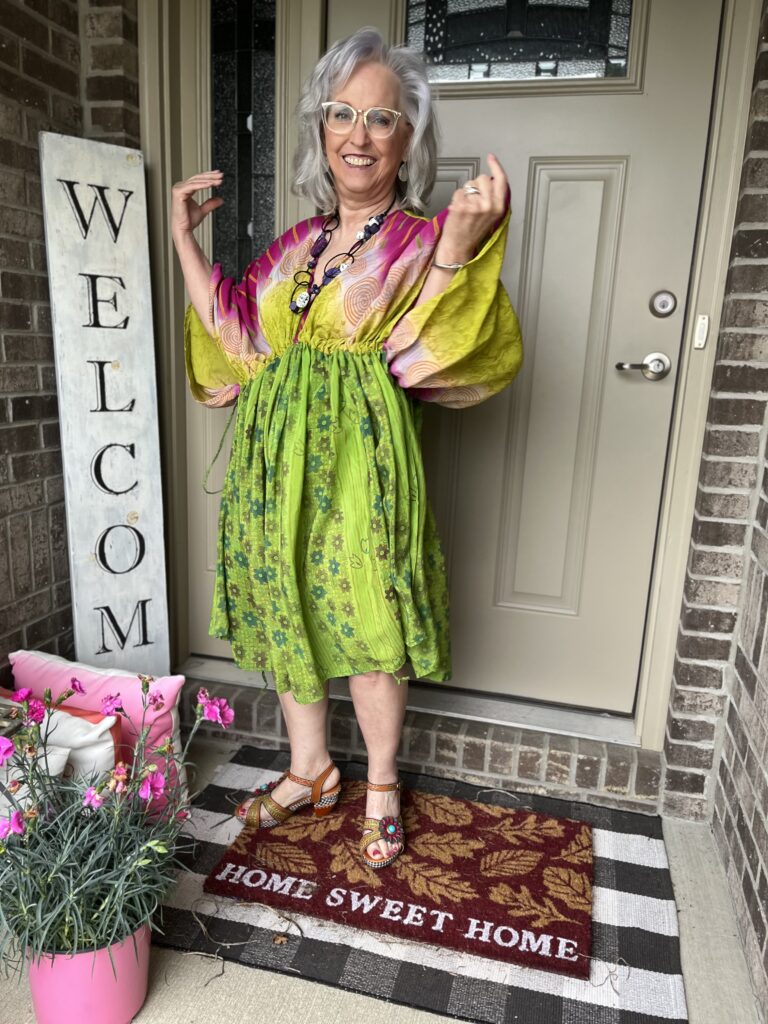
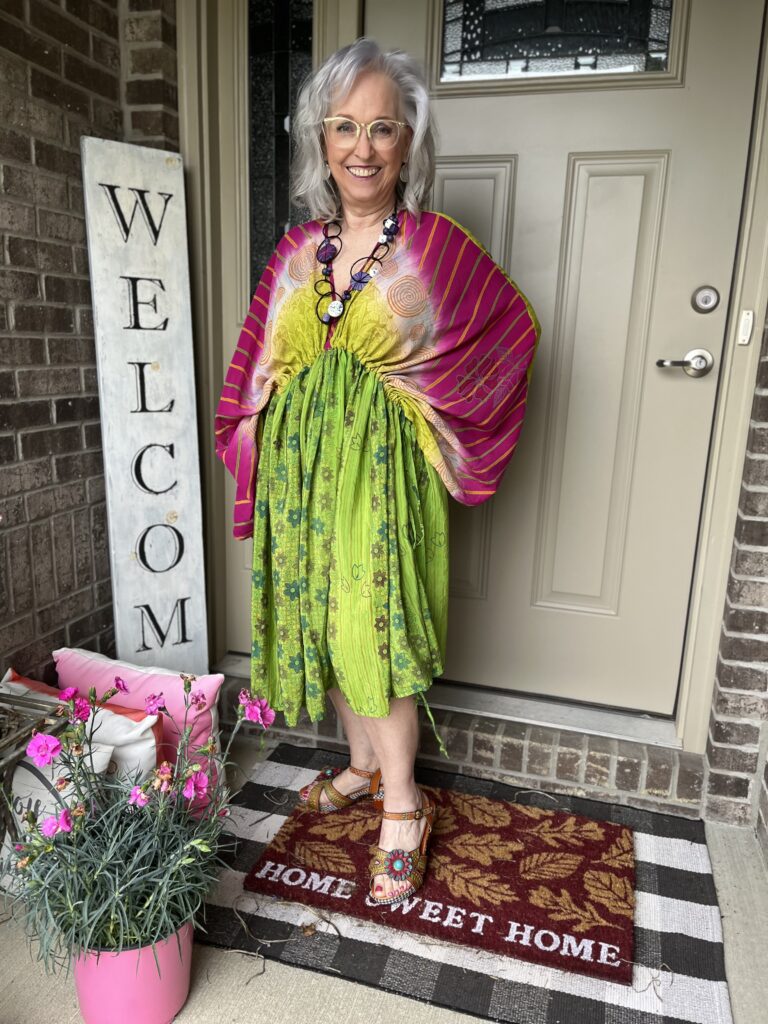
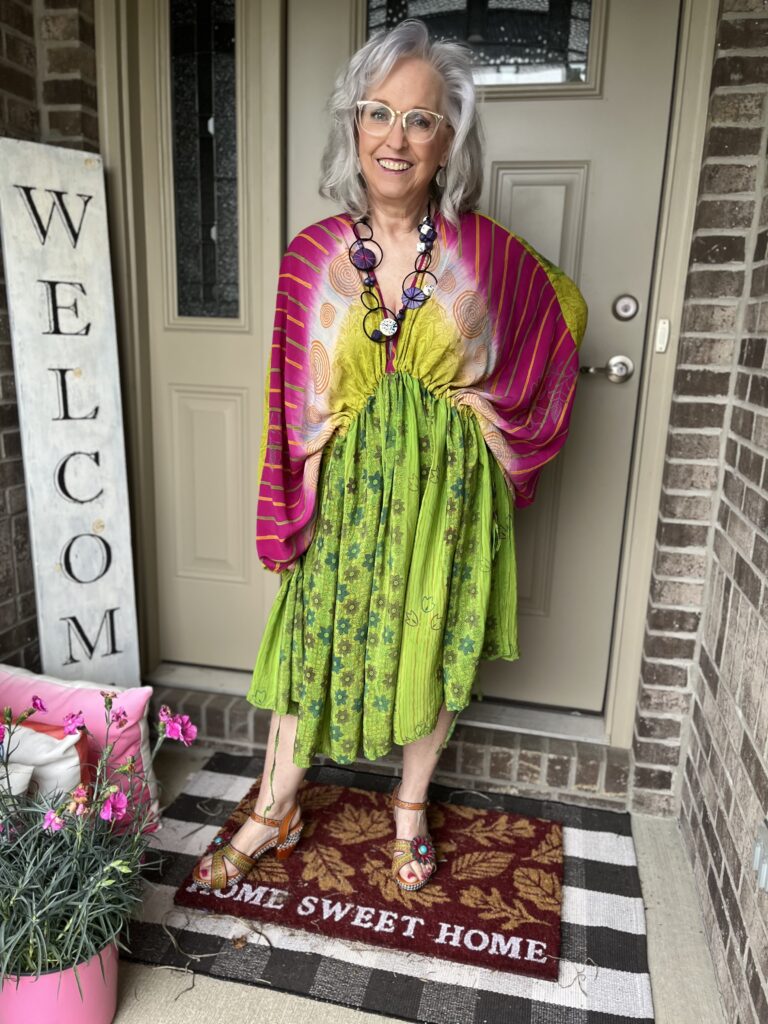
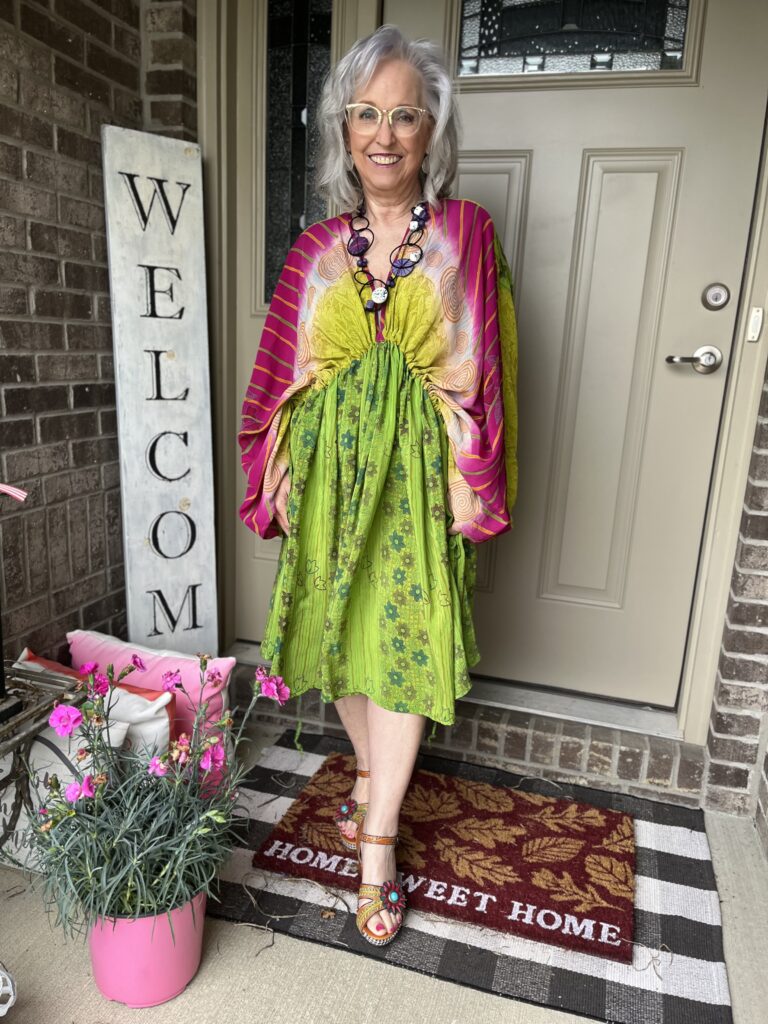
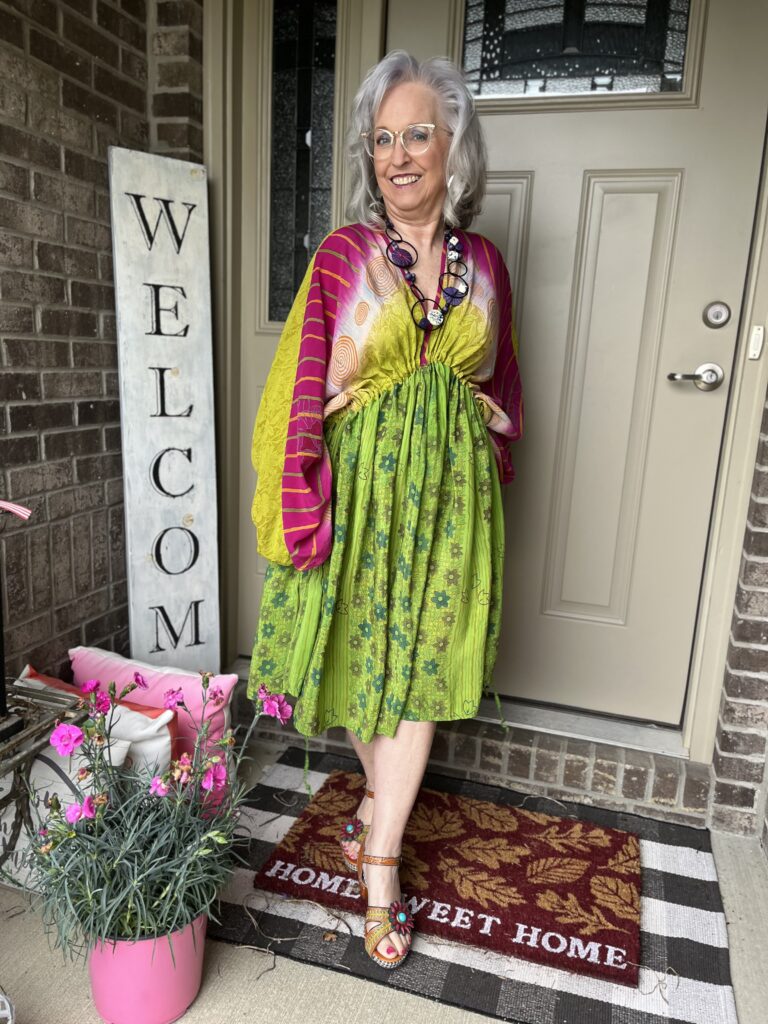
Now, I know many of you said you thought this would be an easy one. I, however, couldn’t wrap my head around all the different colors, shapes, forms, and lines of both pieces. I even consulted Nigel! I gave him two options. Want to guess which one I chose? This time, I went with my gut. Instead of focusing in on just one part of either painting, I just looked at colors in a sort of abstract way. This is the final piece of my Daenilization! I don’t know exactly what it is. But, I can tell you what it isn’t. It’s not a dress! What you don’t see is that the sides are completely open up to the waist! I told Nigel to be on the lookout for something showing that shouldn’t! This top/tunic is from Kantha Bae, but I have no idea what it’s called. You can see that it has long, long, long ties that gather under the bosoms. But, what I really want you to look at are the colors! I think there are many that appear in the Rivera paintings as well as some that don’t! I think it’s a joyful piece much like I think the paintings exude joyfulness. I’m going to have to figure out what to wear (other than jeans or leggings) with this because it really is a breathtaking piece! Thanks, Daenel!!

The Lewk!



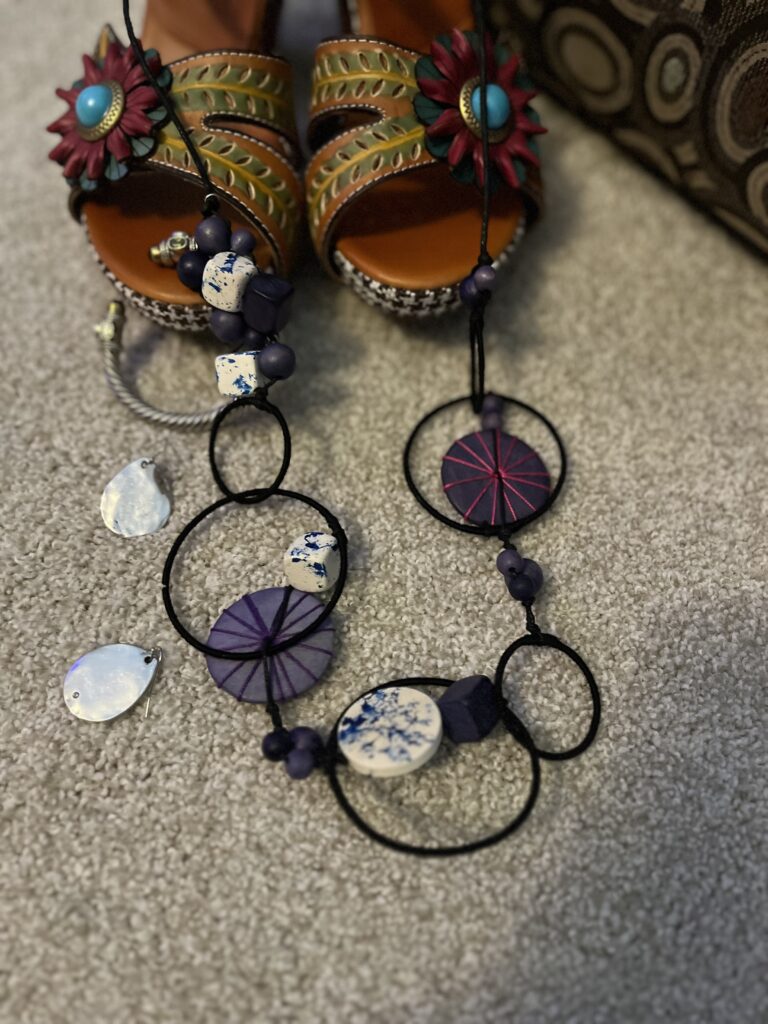
I’ve discovered a new love…Sylca Designs! This is the Purple Hayden Disk necklace. I’m not sure if you can tell, but the black wax cord is adjustable. It’s got those nifty little knots you can pull apart or push together to lengthen or shorten the necklace. I love that! I pulled it up to fill in the decolletage. I goofed and didn’t buy any earrings to go with it so I’ll be adding some of those soon. In the meantime, I went with these silver drops from J Jill. I know the dancers are barefoot, but it’s been cold and rainy here in Central Indiana. I thought my L’Artiste Astarr in camel gave off the appropriate vibes for the art.
Wrap it up, Marsha!
Man, Diego Rivera was some kind of guy, right? I find that time period so fascinating. I don’t know that it would have been so great if you weren’t a part of that whole artist scene, though. And, of course, WWII was looming during this particular time period. I did find it interesting that Rivera was so absorbed by his Jewish ancestry yet was an atheist. So, can we talk? How do you feel about artists of any kind who are problematic as Rivera was in the 50s in the United States? Do you think the art should speak for itself, or does the artist play into it, too? Which of the two pieces of art speaks to you most? Please leave me a comment or two, and we can talk. I promise to respond as quickly as I can.

Don’t forget…
If you want to be included in the Style Imitating Art round up, send Shelbee your photo by 10:00 pm EST, Tuesday, May 6th. Photos of everyone participating will appear on my blog on Wednesday, May 7th! If you’re interested in joining us, consider all of your options…the colors, the objects, the memories they evoke! Come on, give it a try! I think you’ll love it!

Thank you!
I want to thank all of you from the bottom of my heart for reading, commenting, subscribing or emailing! It truly means so much to me! If you’d like to follow me on Instagram, you can find me here.

Affiliate links, discount codes and such:
Just a reminder that Marsha in the Middle may use an affiliate link. Those links are usually italicized. If you click or make a purchase from an italicized link I provide, I may receive a small commission at no cost to you. Thank you for your support. Use Marsha12 for 12% off any order of $65 or more at Buykud. I have also become a Halftee Partner. Use the code, MARSHA2098, for 20% off any purchase. I am also an affiliate with Clara Sunwoo. You can use my code, MARSHA10, for 10% off your entire order. In case you didn’t know, bloggers must disclose the use of affiliate links. That’s why I include this in each post.
Where you can find me:
Linking up with Nancy’s Fashion Style, Fine-Whatever, Is This Mutton, Shelbee on the Edge, Chez Mireile, Suzy Turner, and Away from the Blue as well as Deb’s World and A Fresh Cup of Coffee. I also link up with This Blonde’s Shopping Bag, Doused in Pink, I do deClaire, Mummabstylish, Style Splash and Elegantly Dressed and Stylish as well as the Senior Salon Pit Stop (Esme’s Salon) and Slices of Life. Please check out these wonderful ladies and their blogs! I also am a co-host for Ageless Style on the third Thursday of the month and Songful Style on the last Monday of the month. I co-host Traffic Jam Weekend every Thursday with Melynda, Lisa, and Sue. I also host Final Fridays on the last Friday of the month as well as 10 on the 10th on the 10th of the month! I do hope you’ll check out all of these blogs and link parties!
Wow, that is a creative outfit, I wouldn’t know where to begin with it!
Thank you, Rosie! Sometimes, I get lucky, and a piece just sticks out and says, “Here I am!” That’s what happened here.
That is such a fun and colorful outfit!
Thanks, Joanne! It is, indeed, very colorful!
My comment disappeared, so I’ll try again.
To be honest, the sleeves would be too long for me. I can hardly stand standard length and usually wear 3/4. It does catch the vibes of the paintings well, though!
I looked at the AD article via our library’s license for the e-journal and all it really says is “Diego Rivera’s 1928 Dance in Tehuantepec hangs on elm paneling above a seating group”.
Here’s something interesting, too https://inequality.org/article/americas-billionaires-borrowing-their-way-to-ever-more-fabulous-fortunes/
For the one from 1935 I found this https://collections.lacma.org/node/240567
https://catswire.blogspot.com/
I wonder why your comment disappeared. I didn’t get a notification for it. WordPress has a mind of its own lately! And, it’s quite convoluted. That article is infuriating, isn’t it? I linked to the article of the Bronfman woman standing in front of her Rivera painting. Interesting they use it for collateral just to make more money. I mean, honestly, these people probably couldn’t even begin to spend all the money they have. It’s disgusting. Rivera certainly would have been infuriated.
As for the sleeves, yeah, they are a bit of a bother, but I haven’t worn this enough to work out they work. They can’t just be for show!
Thanks, Cat, for the additional information!
This Style Imitating Art challenge sounds so interesting. What a creative way to find fashion inspiration. Diego Rivera certainly lived a fascinating life, and his artistic journey is quite a story. I’m intrigued by the idea of interpreting art through personal style.
Thanks, Benita! We’d love to have you join us! It’s really fun figuring out how to interpret the art…either literally or figuratively!
Oh my word, this Daenel garment is absolutely stunning! I love all the bright colors, the fun patterns, and the unidentifiable garment style! Long flowy anything is totally my jam! I did not struggle with styling this artwork but I guess that’s because I chose it! LOL I did struggle, however, with finding much information about the paintings. Much of what I found was contradictory or just plain old confusing. That’s why I went with both paintings because I kept finding conflicting and overlapping information about them. In any event, you and Salazar both created gorgeous outfits for this prompt despite your struggles! Well done, as always!
Shelbee
Thanks, Shelbee! I think this is my second favorite piece after the reversible skirt. I love the colors which are probably not colors I would buy for myself, yet they’re gorgeous! I was equally stumped on the paintings. I could never really find out where they actually are. I did find an article (behind a paywall), but the owner of the apartment (which I couldn’t afford in a million years) was standing in front of one of the paintings! For some reason, one google search kept sending me to the Philadelphia Museum of Art which didn’t appear to have it. Then, I saw it belonged to the LA Museum of Art. You definitely found more than I did! I think this was a difficult challenge, but it was really fun when I decided to go with my feelings instead of being literal!
I love that you channeled the overall feel of both paintings in creating your outfit. It captures the bold colors and prints, the multitude of shapes, and the swishy factor of the artwork really well! It’s a great example of bypassing specific details in favor of the feeling and vibe of an artwork.
Thanks, Sally! I just couldn’t do a literal anything with this. I think my brain was on overdrive and was just seeing colors and shapes. I really think both of these paintings are so joyful (even though they may not be intended that way), and I definitely felt joyful in this dress or thinkamajig!
Heeehee, you’re funny,! Love that the dress is open on both sides. The color or richness of the outfit you chose is perfect for the interpretation. I love Impressionism. So you said Post Impressionism and cubism. That is interesting. I enjoy seeing each persons interpretation of art. My brother used to work for the Smithsonian I nDC. Would you believe I haven’t been there!
Thanks, Jess! I honestly didn’t realize it was open at the sides until I was twirling around in the bathroom and noticed! There’s so much fabric you don’t notice until you need to! If you look at Rivera’s earlier work, you can definitely see the Cubism. I love Impressionism the most, I think, because it’s just so ethereal. Yet, I’ve also found I like the more Academy realistic paintings, too. That’s really cool your brother worked for the Smithsonian. It’s huge, and I love all the different museums. I can’t believe you’ve never gone. Well, probably don’t go this summer…DC is miserable in the summer!
Great example of how looking at the paintings abstractly could give you inspiration.
Absolutely stunning 😍
Xoxo
Jodie
Thanks, Jodie! I just couldn’t make anything work, but I could go with my feelings. These paintings give me a sense of joy, and this dress or whatever it is certainly does that!
I love Diego Rivera and the paintings you chose for the style challenge! Your dress is perfect! So pretty and colorful!
Jill – Doused in Pink
Thank you so much, Jill! I’ve heard of Diego Rivera, but I’ve honestly seen his art more. I love the movement and the colors in it. I’m going to be on the lookout for it now in art museums I visit!
I love what you chose! The colors and prints are stunning. I also love that this tunic cinches at the waist. So flattering!
https://www.kathrineeldridge.com
Thank you, Kathrine! I thought the colors worked really well with these paintings.
Hi, Marsha – This piece of clothing is the perfect choice to represent the color, movement and dance of the paintings! You know how Kantha Bae would style it: with wide-legged or harem pants. You could also wear a slip or skirt under it. We own a copy that my husband collected of the Detroit Institute of Arts mural by Diego Rivera. An artist must be free to interpret society with creative license, so all that getting kicked out of places was horrible judgement and bad politics by evil, corrupt people. Because the best art is the boldest statement in observation of the world as the artist sees it. Also, creative or artistic genius is often an expression of some sort of insanity, it seems, if proven by a procession of historical figures. Thanks for researching this in-depth biographical account. Fascinating – Angie, http://www.yourtrueselfblog.com
Thanks, Angie! That is really cool you have a copy of the Detroit Institute of Arts mural. I’m so glad you shared this about artists and creative license. I think it’s what I’ve been trying to say. I was listening to the Don McClean song about Vincent van Gogh, and it moved me to tears, knowing he did some of his most creative work while “resting.” So, that insanity must be apart of the creative process in so many.