
Style Imitating Art…
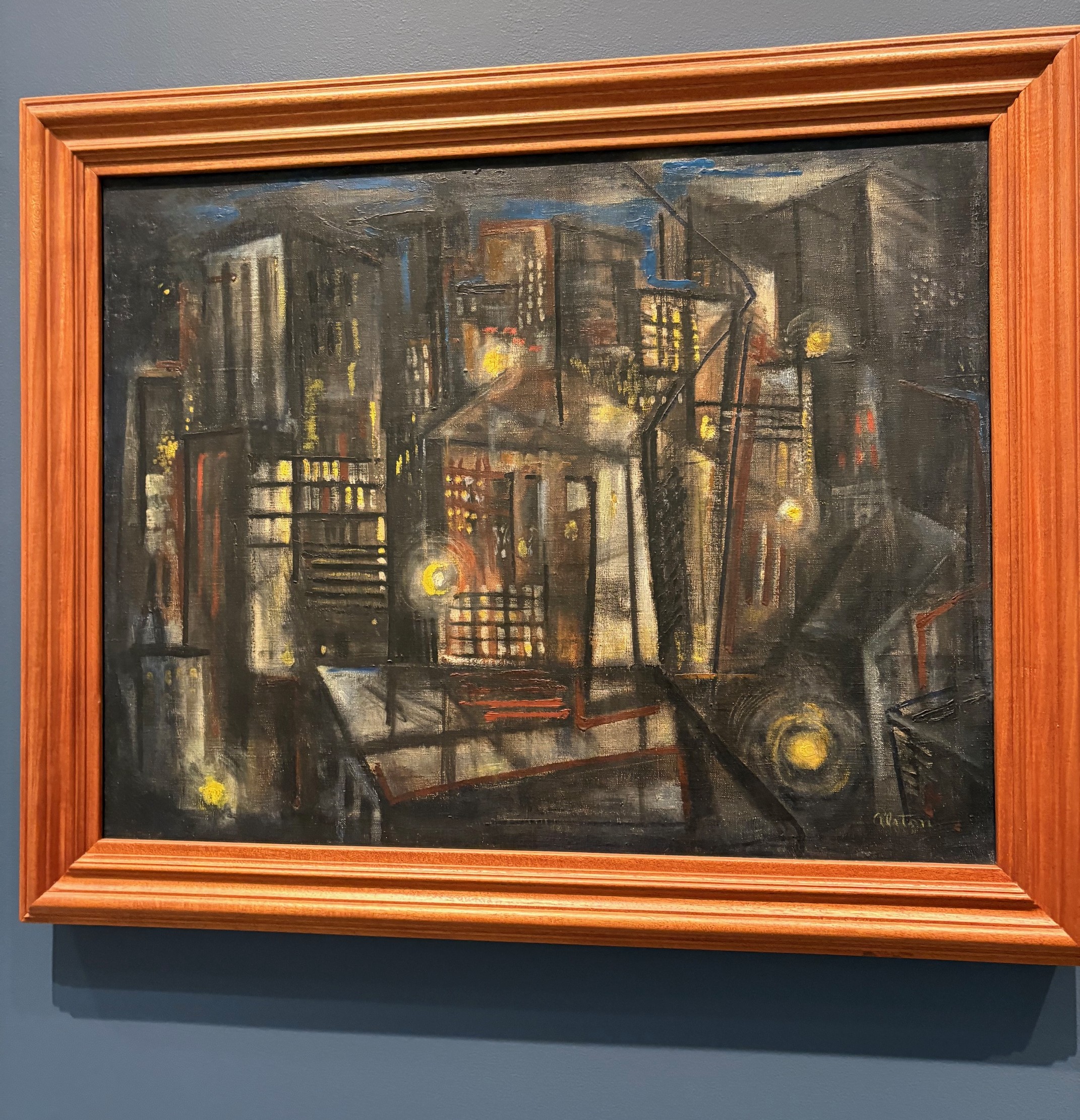
Welcome to the very first Style Imitating Art of 2026. Salazar, Shelbee, and I are the curators. You can think of this series as fashion meets art museum! SIA challenges people to find inspiration in different art works, create looks based upon that art work, and share them with the curator for that piece. I am this week’s curator with this amazing painting. I hope you enjoy this post, the information, and my interpretation.
How it works…
Every other Monday one of us selects an inspiration piece of art and posts the image on their blog. We then invite others to interpret that art work through their style. The following Monday, we share our outfits. The curator shares submissions the following Wednesday on her blog. I chose this week’s art work for this round of Style Imitating Art. If you’d like, you can read why I chose it here. Please send your photo to me by Tuesday, January 13th, 2026 by 10 pm EST. Style Imitating Art is an interesting way to inspire your outfits. You can see a few of my looks here, here, here, and here.
The artist…
Charles Alston, a leader of the Harlem Renaissance, was the son of a former slave and was born on November 28, 1907 in Charlotte, NC. After his father’s death in 1910, his mother, Anna, married Harry Bearden in 1913. Romare Bearden, another African American artist, writer, and songwriter became his cousin, through marriage, although the two were already good friends. In 1915, the Bearden/Alston family moved to Harlem in New York City as part of the Great Migration. This was, in part, to escape the Jim Crow laws enacted in the South. Alston showed artistic abilities from a very young age, creating “sculptures” from the North Carolina clay as well as drawing.

A little more…
Alston graduated from DeWitt Clinton High School. He was nominated for academic excellence, was the art editor of the school’s magazine, The Magpie, was a member of the Arista-National Honor Society as well as studying drawing and anatomy at the Saturday school of the National Academy of Art. He graduated in 1925 and was awarded a scholarship to the Yale School of Fine Arts. He turned this down for a number of reasons (here is a link to an excellent interview with Alston). He chose, instead, to attend Columbia University.
Still more…
Initially, Alston was in the architecture program, but he realized his math abilities weren’t where they needed to be. He also recognized Black architects did not receive commissions for the kinds of projects they might want to do. While at Columbia, Alston worked, for a year, as a boys’ work director at a small community house in Harlem called the Utopia House. He was insistent (in the interview mentioned above) he discovered Jacob Lawrence there during an art class he taught. He says:
“Mothers used to leave their children at Utopia House in the morning while they went to work; they’d have a program for them, and then the parents would pick them up after work. Jake was one of these kids. I had an art class as one of the activities and Jake was interested. And I noticed almost immediately what an interesting eye this kid had. He didn’t work like the other kids. He knew pretty definitely what he wanted to do and it didn’t relate to the typical kind of thing that children of that age do (source).”
Even more…
Alston was a bellhop during the summer following his first year at Columbia. Many of the bellhops with whom he worked were going to be pre-med. So, he decided to give that a try. When he flunked a physics test (which covered the exact material he’d had in high school and had earned an A), Alston asked his high school teacher what had happened. It turns out that course was one of the weeder-outer courses. You know the ones. They make them hard or difficult to understand on purpose, and those who can’t take the heat, leave the kitchen. Alston also realized during this time, medicine wasn’t for him. He finally gave in and took the art classes he’d wanted to take all along. In 1929, he graduated and received the Arthur Wesley Dow fellowship to study at Teachers College where he obtained his Master’s in 1931.
Still more…
Alston served in the U.S. Army during World War II, specifically in 1942-43, stationed at Fort Huachuca in Arizona, where he worked as an artist for the Office of War Information and Public Relations, creating posters and illustrations to support the war effort. He met Myra Adele Logan, a surgical intern at Harlem Hospital. They married on April 8, 1944. During the 30s and 40s, Alston created illustrations for magazines like Fortune, Mademoiselle, The New Yorker, Melody Maker, and others. He also designed album and book covers for artists like Duke Ellington, Eudora Welty, and Langston Hughes. He was the staff artist at the Office of War Information and Public Relations in 1940. These included drawings of notable African Americans and were used in over 200 Black newspapers by the government in order to “foster goodwill with the black citizenry.”
Awards…
After leaving commercial work, Alston began creating his individual pieces. In 1950, he became the first African American instructor at the Art Students League. He would be on the faculty until 1971. In 1950, his Painting was shown at the Metropolitan Museum of Art. In 1953, the John Heller Gallery presented an exhibition of Alston’s work. From1953 to 1958, he would exhibit there five times. Alston became the first African American instructor at the MoMA in 1956. He taught for a year, then went to Belgium on behalf of the MoMA and the US Department of State. In 1958, Alston was elected a member of the American Academy of Arts and Letters.
More again…
In 1963, Alston, Romare Bearden, and Hale Woodruff founded Spiral which was a large group of artists who would meet to talk and explore how “black artists should relate to American society in a time of segregation.” Many described Alston as an “intellectual activist.” In 1968, he received a presidential appointment from Lyndon Johnson to the National Council of Culture and the Arts. In 1969, Mayor John Lindsay appointed Alston to the New York City Art Commission. In 1973, he was a full professor at City College of New York. He had taught there since 1968. In 1975, he received the first Distinguished Alumni Award from Teachers College. The Art Student’s League created a 21-year merit scholarship in his name to commemorate each year of his tenure.
Harlem…
One of the most important things to remember about Alston was his influence on the Harlem Renaissance. He believed Harlem to be the cultural center of New York City during the years prior to the Great Depression. He said,
“The thoroughfare, the promenade was Seventh Avenue. And Seventh Avenue was a very handsome street. And of a Sunday you’d stroll along Seventh Avenue in your best clothes and look over the passing parade of beautiful gals, you know. The 135th Street corner was our meeting place. You could stand there and in the span of a Sunday afternoon see anyone who was anybody in Harlem. The night life was fabulous. The corner saloons, back rooms jumped, you know, places Like Hotcha and Mike’s and little places that had back rooms. You’d go into Hotcha and Bobby Henderson was playing the piano, Billie Holliday was singing. You’d go across Lenox Avenue to the little bar across from Harlem Hospital and Art Tatum was playing the piano. Ethel Waters was here. The place just jumped. Dickie Well’s place on 133rd Street. God, some of the names escape me. Tillie’s Chicken Shack. Gladys Bentley’s Place. And you sort of did a tour. In the evening you’d pop from place to place. And, as I say, you had as many people from downtown in Harlem in those days as you had Negroes and nobody thought of anything happening to them. You went through any side street . . . some of these little joints you had to go down through a basement, through a yard and have people open up so you could be identified. but it never occurred to you that anything would happen. That’s a long time ago (source).”
Critical appreciation…
Alston experimented with and used many different ways of making art. Alston quotes the art critic, Emily Genauer:
“I remember Genauer said once about an exhibition I had, she reviewed it and one of the remarks (I don’t know whether she meant it as criticism or not but I always thought it hit it right on the head as far as I was concerned); she said “Alston refused to be pigeonholed.” And that’s been true. I mean I do a series of abstract paintings concurrently with a series of figurative paintings. I’ll do very realistic things — I don’t mean academically realistic things — and very far out avant-garde things. And I don’t stay too long with one of them if I can see the logical conclusion of it. I mean I’m curious about …I want to explore different and new unknown territory…I couldn’t do this kind of thing where some painters…You go and you see twenty paintings and they’re variations of the same thing, maybe it’s a horizontal band of color and a couple of blobs and variations on that. That would bore me stiff. On the other hand, there’s no consistency about it because there have been several recurrent themes in a period of my work, let’s say, twenty years or so. They manifest themselves in various ways but they’ve been pretty consistent in their reappearance periodically in my work — the family, for one thing, the blues, a group of paintings I call “African themes,” These are just sort of variations on thoughts about African sculpture, African design, African pattern, that kind of thing. Those three themes have been pretty recurrent, and along with this a protest theme. Every once in a while you just get angry enough to do a very definitely protest picture. I suppose it was about five years ago I did practically nothing but abstract paintings, pretty much or somewhat abstract expressionist in background. And then all of a sudden I felt the need for the figure. I’m really impatient with the impersonality of most of the things I saw around me and for me I’ve always had this need for a contact with the human thing, you know. And I just deliberately began working with figures. And I think essentially that’s why I am a figure painter. I’ve got a curiosity, maybe too much so, so I can’t resist the explorations into painting that I know isn’t particularly me. On the other hand, I’ve always felt that I’ve brought back something from these things that goes into your painting and enriches it. But I think primarily I’m a figure painter and I’m concerned about people (source).”
On being a painter…
Al Murray, when interviewing Alston for an oral history, asked him what it means to be a painter, Alston replied:
“What do you mean, a painter as a painter? I mean before you’re a painter you’re a human being and you’re involved in what happens. And I think this creates quite a few problems for the painter. Certainly I know if you are sensitive in any way you’re concerned about all of the aesthetic questions that are involved in painting. You’re concerned with what goes on in the international scene, about general developments in art, new movements, new attitudes, new ways of seeing, completely on an aesthetic level. You can’t help at that same time — that’s why I think the Negro painter in this country has a slightly different problem from a white painter — you cannot, while you’re concerned with these things that involved the aesthetics of art, you cannot but be concerned about what’s going on around you and how it affects you, your people, this kind of thing. So that you’re torn — at least I know I am — you continuously ask yourself the question: Is this the way I should paint? Or is this important with things going on here? Picasso I think said that art is a weapon. Should I commit my painting to visualizing, as I see it, the struggle that’s going on? Or should I close my eyes and keep myself and my painting apart from that, involve myself perhaps in other ways that relate to the struggle but keep the painting apart? Right now these are questions I think that most Negro artists have to ask themselves. Now you take a person like Ralph (Ellison). Ralph insists that you keep the art apart (source).”
Finally…
Charles Henry Alston passed on April 27, 1977, from cancer just a few months after his wife, Myra, died from lung cancer. He is interred at Riverside Church Columbarium in New York.
The artwork…
Harlem at Night is currently on display at the Indianapolis Museum of Art at Newfields. It is oil on canvas and measures 28 x 36 in (71.12 x 91,44 cm). Including the frame, the piece measures 36-7/8 x 45 x 2-1/8 in (92.25 x 114.3 x 5.4 cm). It is signed and dated in yellow paint on the lower right. There are elements of Cubism in this painting as well as some African art influences. Believe me when I tell you this photograph (taken by yours truly) doesn’t begin to do the painting justice. It is vibrant, full of movement, and overall breathtaking!
My interpretation…
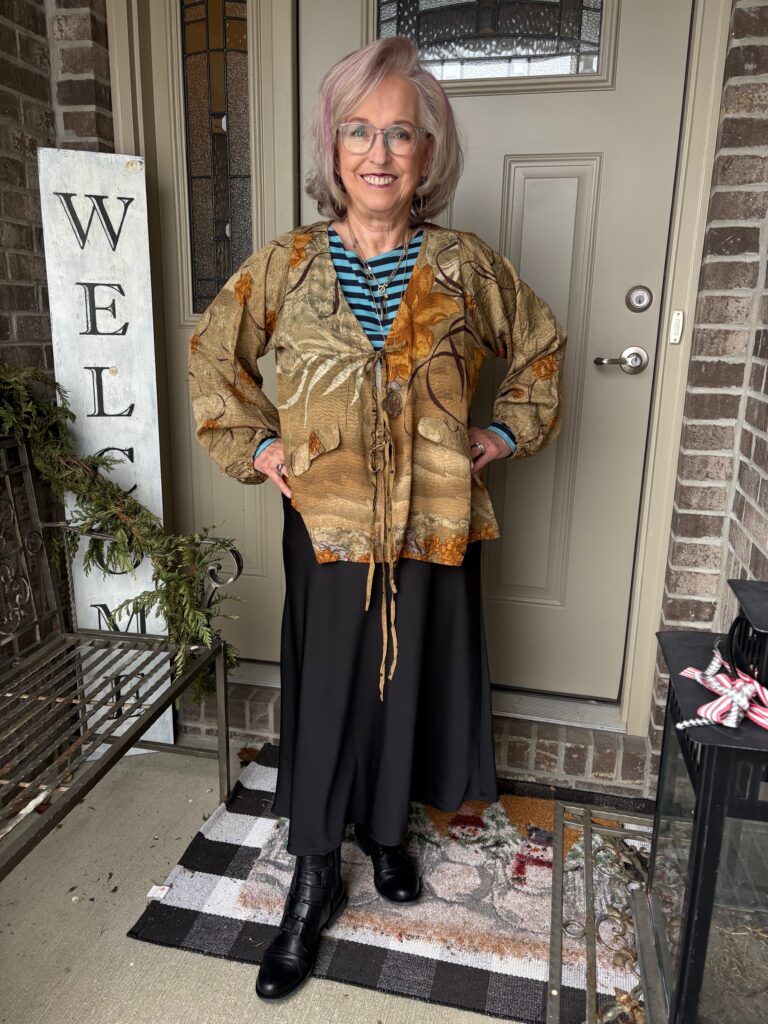
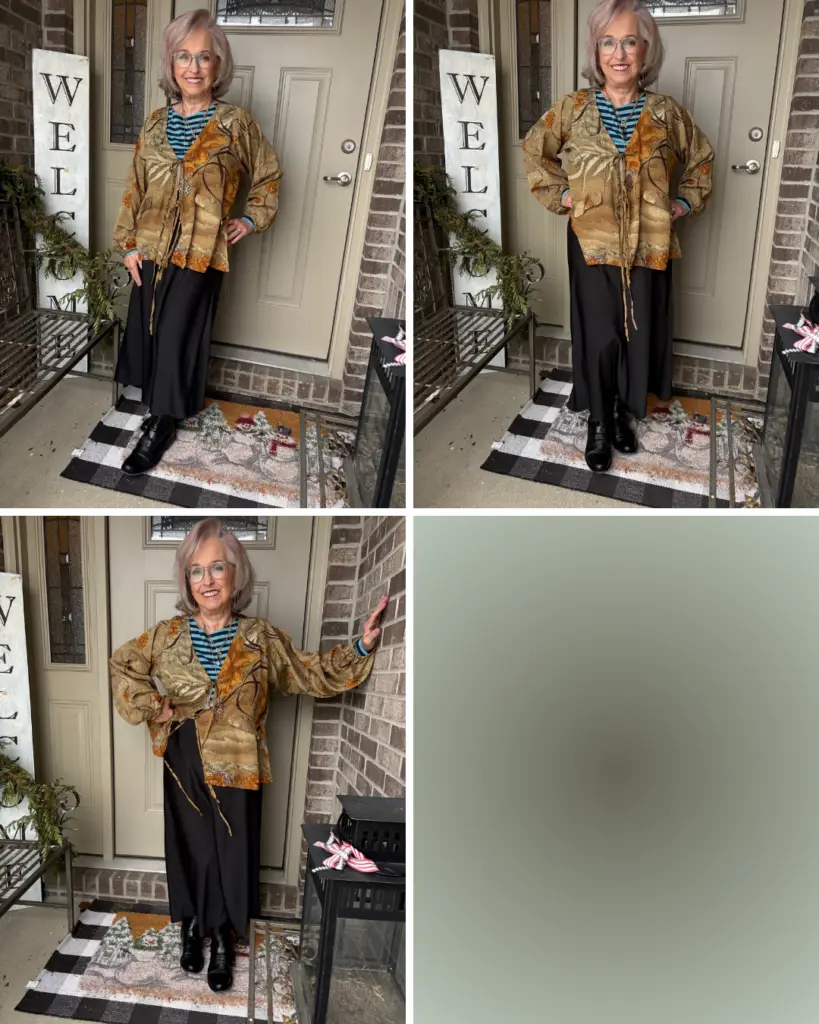
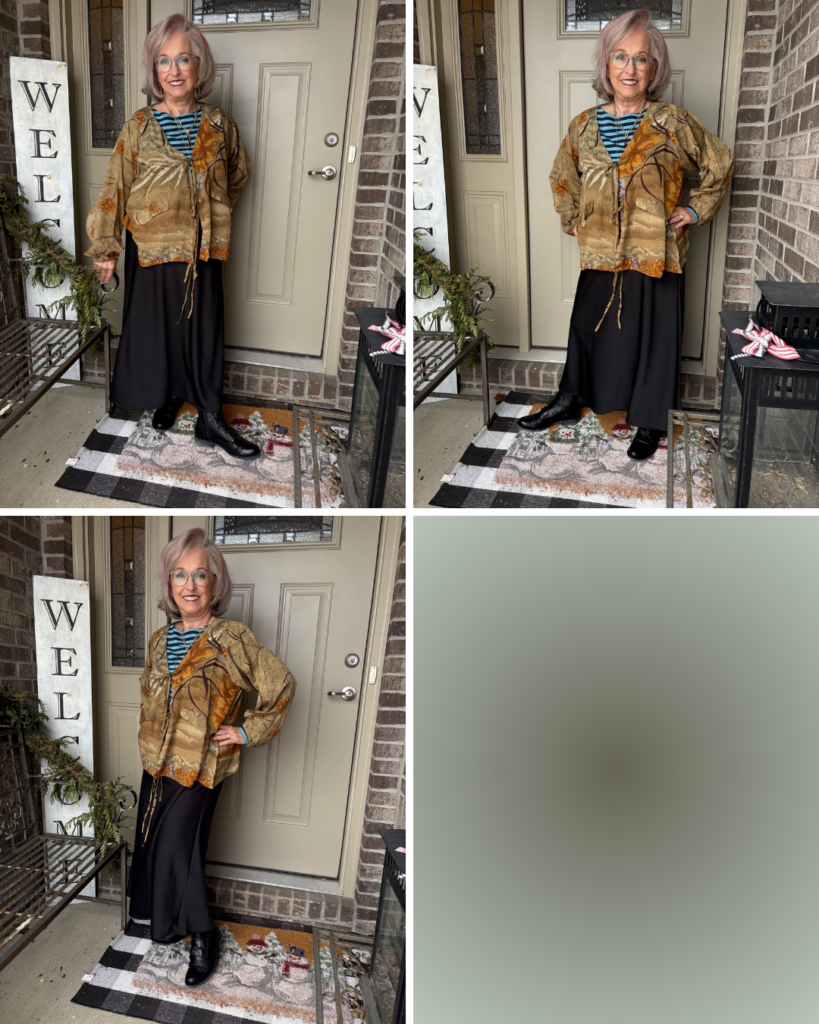
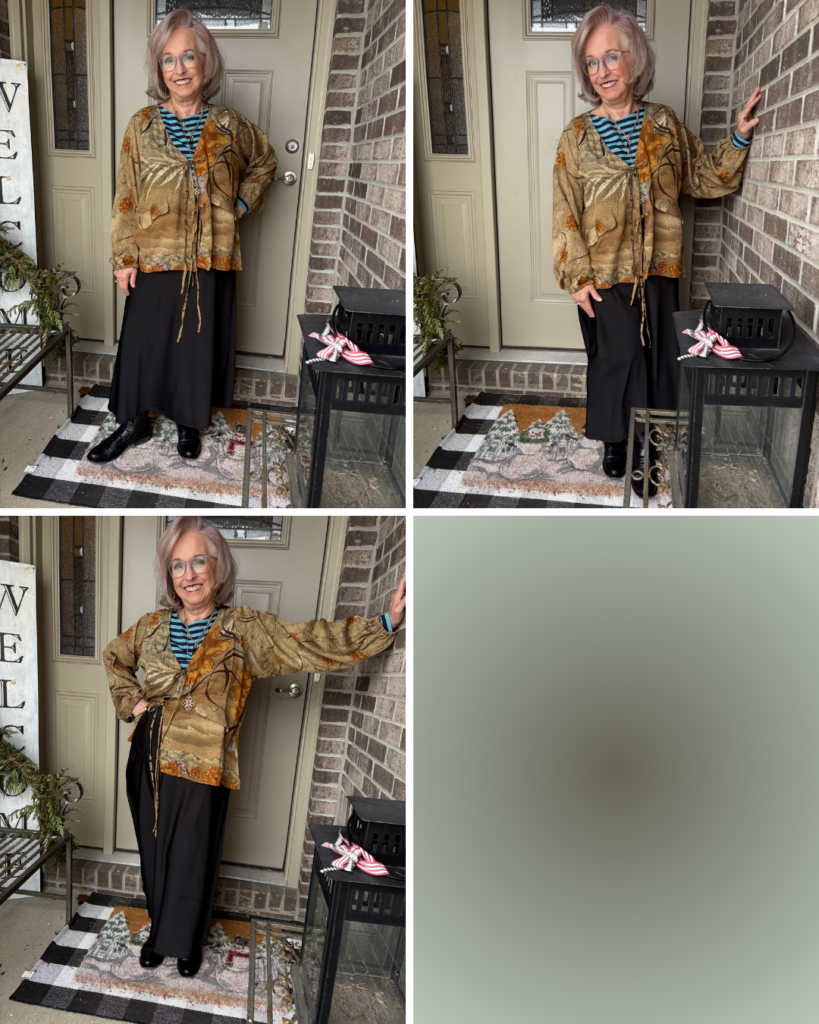
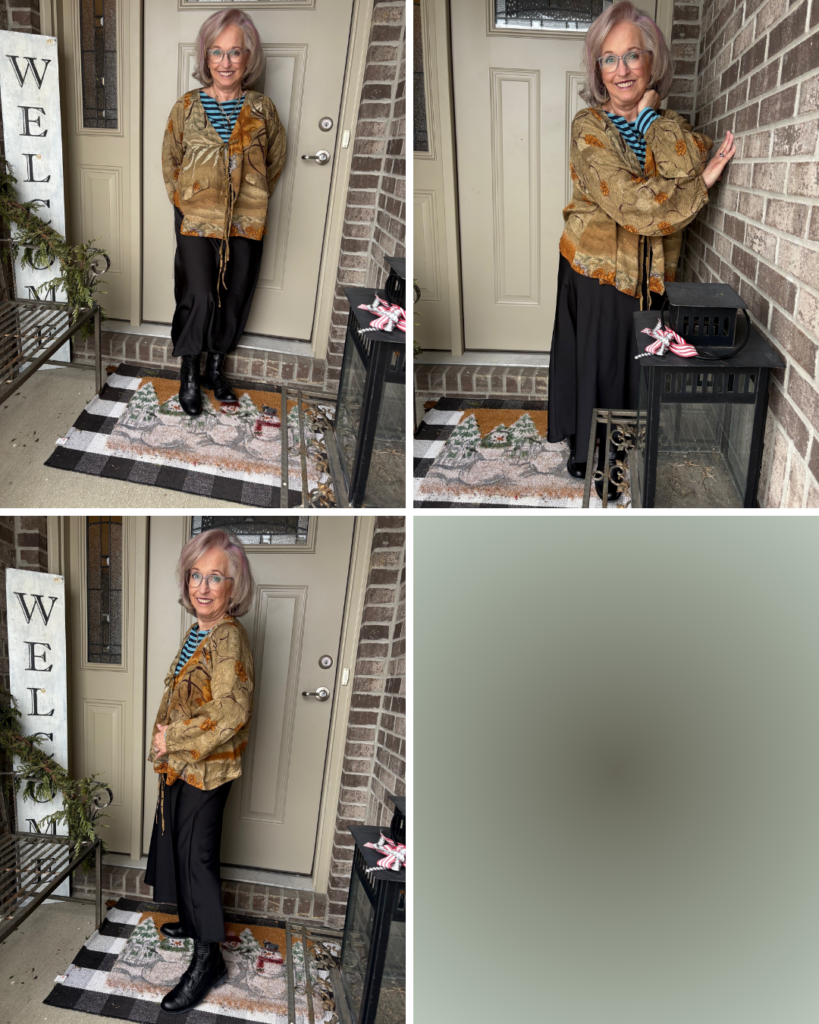
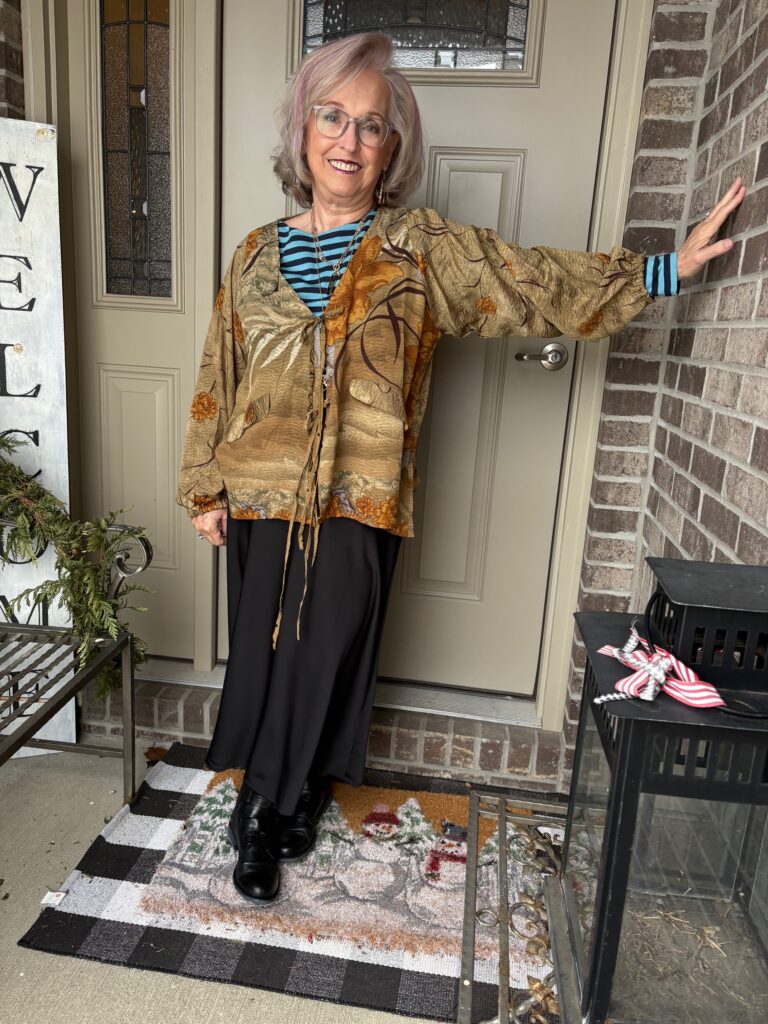
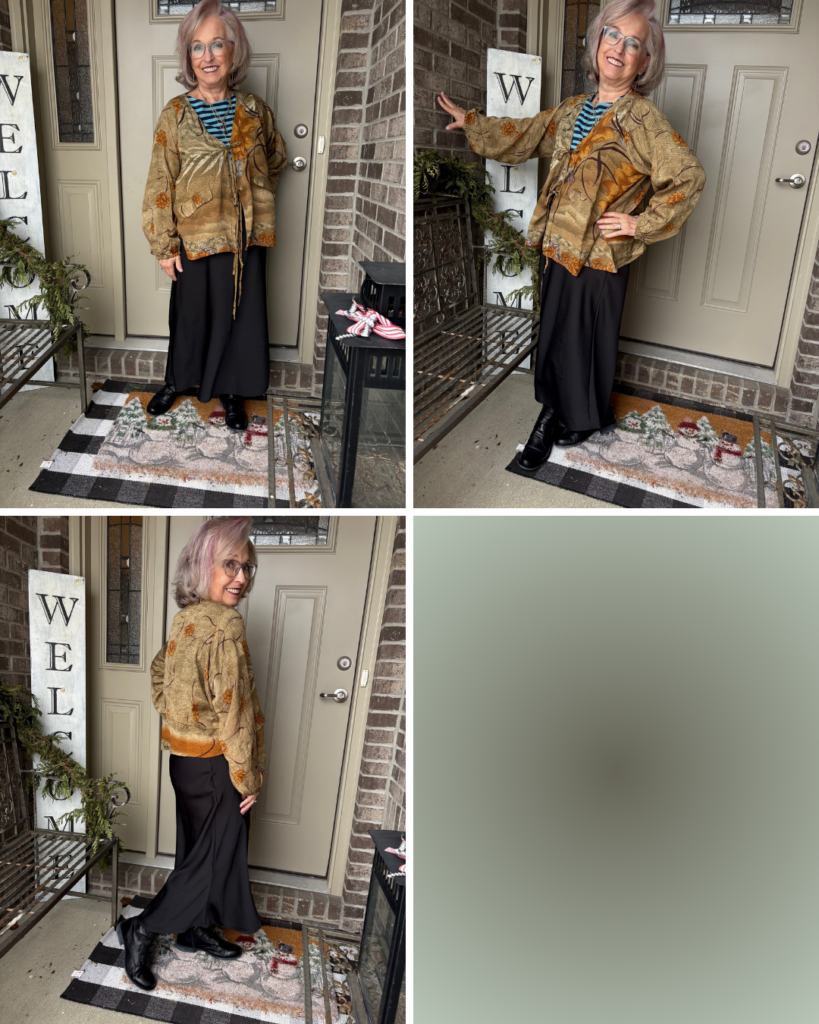
I knew this was going to be a hard one for me because of those sharp black lines. I went searching through my closet and came up short. The few things I have that are striped and would be a major player in my interpretation were navy/white combos. I decided to look more closely at the art, and what struck me was the abundance of yellows and ochres in it. I had just gotten this Daisy Blouse from Kantha Bae and thought the colors in it were perfect for those in the painting. I then added a black slip skirt from Old Navy. I wanted to really pull out the blues in the painting though they aren’t as vivid in the photo as they truly are. I went looking again for something in the right tones of blue, and what do you know? This tee from Gudrun Sjoden just happened to be striped! All in all, I think I did a pretty good job with interpreting Alston’s Harlem at Night. I used this painting as part of my New Year’s Eve tour at the museum, but I didn’t wear this outfit. I’ll do another post on that one, maybe next week, because the look as well as the tour deserve their own post!
The Lewk!
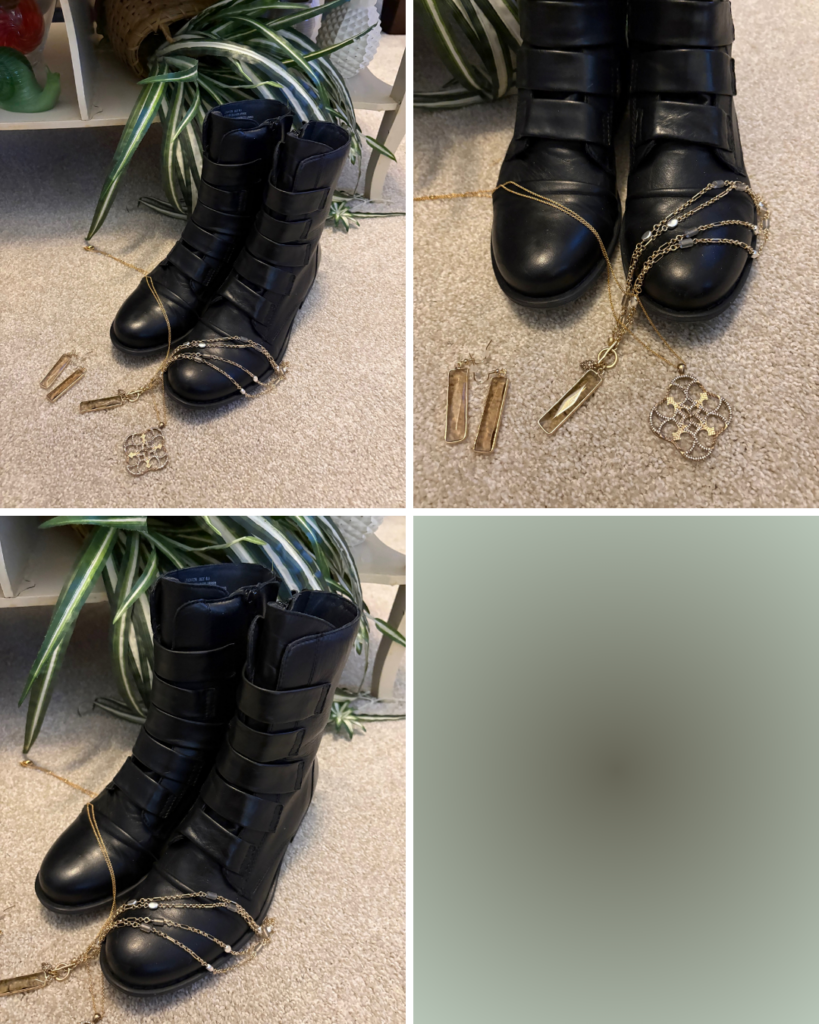
OK, I confess! I bought the Miz Mooz Leighton boots in black. My black Born boots are beginning to show some wear, and I know these boots are comfortable right out of the box. I added a J Jill necklace and matching earrings along with a very old Stella & Dot necklace to further showcase the golden colors in the painting.
Wrap it up, Marsha!
Honestly, I don’t really think I did Charles Alston justice in this post. The man was truly a Renaissance man for his time…for any time, really. He did it all. I encourage you to read this interview. It will give you so much insight into the man. It is a very long interview, but it’s well worth the time if you liked this painting or are interested in the Harlem Renaissance. So, can we talk? Were you aware of either the Great Migration or the Harlem Renaissance? What do you know about Cubism? Would you have come to my New Year’s Eve tour to discover more about Alston? Please leave me a comment or two, and we can talk. I promise to respond as quickly as I can.
Don’t forget…
If you want to be included in the Style Imitating Art round up, send me your photo by 10:00 pm EST, Tuesday, January 13th. Photos of everyone participating will appear on her blog on Wednesday, January 14th! If you’re interested in joining us, consider all of your options…the colors, the textures, the feelings they evoke! Come on, give it a try! I think you’ll love it!
Thank you!
I want to thank all of you from the bottom of my heart for reading, commenting, subscribing or emailing! It truly means so much to me! If you’d like to follow me on Instagram, you can find me here.
Affiliate links, discount codes, and such:
Just a reminder that Marsha in the Middle may use an affiliate link. Those links are usually italicized. If you click or make a purchase from an italicized link I provide, I may receive a small commission at no cost to you. Thank you for your support. My April Cornell code, MARSHA15, now works, but it’s good for only one use. You can get $15 off $100. I’d wait and use it during a really good sale! Use Marsha12 for 12% off any order of $65 or more at Buykud. I have also become a Halftee Partner. Use the code, MARSHA2098, for 20% off any purchase. I am also an affiliate with Clara Sunwoo. You can use my code, MARSHA10, for 10% off your entire order. Use MARSHA15 at Katia Designs for 15% off your order. In case you didn’t know, bloggers must disclose the use of affiliate links. That’s why I include this in each post.
Where you can find me:
Linking up with Nancy’s Fashion Style, Fine-Whatever, Is This Mutton, Shelbee on the Edge, Chez Mireile, Suzy Turner, and Away from the Blue as well as Deb’s World and A Fresh Cup of Coffee. I also link up with This Blonde’s Shopping Bag, Doused in Pink, I do deClaire, Mummabstylish, Style Splash and Elegantly Dressed and Stylish as well as the Senior Salon Pit Stop (Esme’s Salon) and Slices of Life. Please check out these wonderful ladies and their blogs! I also am a co-host for Ageless Style on the third Thursday of the month and Songful Style on the last Monday of the month. I co-host Traffic Jam Weekend every Thursday with Melynda, Lisa, and Sue. I also host 10 on the 10th on the 10th of the month! I do hope you’ll check out all of these blogs and link parties!
Thank you Marsha, it is good to understand the artist and his work. The top goes very well with the piece.
Thanks, Rosie! I had heard of the Harlem Renaissance and the Great Migration but didn’t really know that much. I truly just touched on the tip of the iceberg that is Charles Alston.
That was really interesting. I can’t remember having heard those two terms specifically and you know I love to learn something new, so thank you! I also bookmarked the interview for now.
Thanks, Cat! I’m glad I introduced you to two new terms though I’m sure there are many terms in German you could introduce to me! The interview is really good but very long.
Marsha, your blouse is beautiful and it really does capture the colors and the essence of the painting. We have featured a few artists from the Harlem Renaissance period for SIA before (Romare Bearden and Faith Ringgold) and I really enjoyed learning about them and the Great Migration. In fact, I have been looking at a piece by Jacob Lawrence for our next challenge (so I giggled when you mentioned him). Since we announce our next art on MLK Day, I thought it would be cool to feature a relevant artwork. I am also considering a painting by Betye Saar and a sculpture by Elizabeth Catlett. I have a few more days to choose which one! If I lived near you, I would have definitely attended your NYE tour!
Shelbee
Thanks, Shelbee! I’d give you the super duper tour, too! I usually check on Salazar’s blog to see if an artist has been used before since she’s been doing this for so long. Oh, I hope you find something by Jacob Lawrence. I don’t know anything about him. It’s so hard to decide, isn’t it?
Pingback:Style Imitating Art | “Harlem at Night” by Charles Henry Alston – Shelbee on the Edge
I loved reading about the history of this artist – what an interesting background! Your top is perfect for the artwork!
Jill – Doused in Pink
Thanks, Jill! He truly made a change in the lives of many which probably didn’t come across in my post. And, thanks for the compliment!
Seriously…that blouse was made for this artwork. I love how you combined it with the blue stripes, and maybe wouldn’t have even thought to do that without the art as inspiration.
XOXO
Jodie
Thanks, Jodie! In my head, the painting had so much more black to it. Then, when I looked at it again, I realized there was a lot of this yellow. I really lucked out! The blouse has just a titch of blue in it so I added the tee. Now, I think I will probably wear them together all the time!
I love the contrasts of the colors and prints. I think it’s perfect paired with this artwork!
https://www.kathrineldridge.com
Thank you, Kathrine! As much as I love the blouse, I think the striped tee drew the whole outfit together!
I love how you so accurately capture the paintings. This one is no exception – your top immediately evokes the harlem buildings.
Thank you, Edi! I am so glad I went back and looked at the painting. I really thought it was mainly black. I was glad I thought of this blouse.
Pingback:Gallery of Style: Harlem at Night! - Marsha in the Middle
The blouse you layered over top is perfect! The colors are a great match for the painting! You did a great job of keeping the outfit moody inline with the painting!
Thanks, Laura! I was so glad I took a deeper look at the painting and realized just how much of that yellow was in it. Oh, I didn’t even think about the moodiness…good point!
Having grown up close to Spain, I know more about Spanish artist like Juan Miro and Picasso.
Love how you went through your closet in search of what would make sense: these challenges definitely help create new brain pathways and make us look at our wardrobes differently.
http://www.chezmireillefashiontravelmom.com
Thanks, Mireille! We do have a Picasso, but I don’t think we have any Juan Miro. I will have to look! I honestly try not to buy anything new for a fashion challenge. I think that kinda defeats the purpose.