

Style Imitating Art…
Welcome back to my interpretation of a stunning piece of art. Salazar, Shelbee, and I are the curators. You can think of this series as fashion meets art museum! SIA challenges people to find inspiration in different art works, create looks based upon that art work, and share them with the curator for that piece. Salazar is this week’s curator with this piece of Pre-Raphaelite art. I hope you enjoy this post, the information, and my interpretation.
How it works…
Every other Monday one of us selects an inspiration piece of art and posts the image on their blog. We then invite others to interpret that art work through their style. The following Monday, we share our outfits. The curator shares submissions the following Wednesday on her blog. Salazar chose this week’s art work for this round of Style Imitating Art. If you’d like, you can read why she chose it here. Please send your photo to Salazar by Tuesday, February 10th, 2026 by 10 pm EST. Style Imitating Art is an interesting way to inspire your outfits. You can see a few of my looks here, here, here, and here.
The artist…
Sir Edward Coley Burne-Jones, 1st Baronet was born on August 28, 1833 in Birmingham, United Kingdom. His father was a Welsh frame-maker. His mother died within six days of his birth so young Edward was raised by his father and the family housekeeper, Ann Sampson. After attending Birmingham’s King Edward VI grammar school and the Birmingham School of Art, Burne-Jones left home to study theology at Exeter College, Oxford. While there, he formed an important friendship with William Morris due to their mutual interest in poetry. They, along with a group of Jones’ friends, formed a society which they called “The Brotherhood.” They read the works of John Ruskin and Tennyson as well as visiting churches. They also idealized the aesthetics and social structure of the Middle Ages. After discovering Thomas Malory’s Le Morte d’Arthur, Burne-Jones’ work would be heavily influenced by it.

More…
Eventually, both Morris and Burne-Jones would meet Dante Gabriel Rossetti, a leading influence in the Pre-Raphaelite movement. Morris had founded the Oxford and Cambridge Magazine to promote their Brotherhood’s ideas. They recruited Rossetti to contribute to their magazine. Rossetti was well-known at this time so his contributions to the magazine could only help the duo. Interestingly, the influencer became the influenced. Initially, Burne-Jones intended to be a church minister. Rossetti, however, inspired the duo to become artists. Burne-Jones then left college before getting his degree in order to pursue art as a career.
Still more…
Rossetti wrote to William Bell Scott in February 1857:
“Two young men, projectors of the Oxford and Cambridge Magazine, have recently come up to town from Oxford, and are now very intimate friends of mine. Their names are Morris and Jones. They have turned artists instead of taking up any other career to which the university generally leads, and both are men of real genius. Jones’s designs are marvels of finish and imaginative detail, unequalled by anything unless perhaps Albert Dürer’s finest works.”
Morris & Co…
You may have recognized the name, William Morris. Burne-Jones was a founding partner in Morris, Marshall, Faulkner & Co in the design of decorative arts. I find it strange he was a founding partner and yet his name is not on the sign!! Hmmm… Anyway, Burne-Jones worked on many of the different crafts available at the new firm: ceramic tiles, jewelry, tapestries, and mosaics. But, his most important designs were for stained glass windows which were having a moment during the 19th century. You can find many of his designs in churches across the UK as well as in the US and Australia.
Oh, those Victorians…
Burne-Jones married Georgiana MacDonald in 1856. This marriage gave him some pretty interesting connections. Georgiana’s sister, Louisa, would give birth to Stanley Baldwin, a Prime Minister of England. Another sister, Alice, was Rudyard Kipling’s mother. So, Burne-Jones was uncle to both by marriage! I think that’s kinda cool. His marriage to Georgiana was fraught with tension at times. Burne-Jones had an affair with his Greek model, Maria Zambaco. Georgiana had her own little dalliance with Morris whose wife had fallen for Rossetti! And, we thought the Victorians were prudes! Both the Burne-Jones and the Morris couples remained married, but Morris and Georgiana would remain “close” for the rest of their lives.

A bit more…
But, back to the art career! As a college drop out who had been studying theology, Burne-Jones had little to no formal training as an artist. He did, however, have a mind stuffed full of classical story and medieval romance. His imagination teemed with these images so he began to practice drawing. While his first works show Rossetti’s influence, eventually, his drawings began to show more “intensely felt elaboration of imaginative detail.” Most of these early works were pen and ink drawings on vellum. Rossetti, himself, soon said he nothing left to teach Burne-Jones. By 1856, he was beginning to sketch in oils. In 1859, he made his first visit to Italy, reveling in the beauty of Florence, Pisa, Siena, Venice, and other places. In 1860, Burne-Jones produced two watercolors, Sidonia von Bork and Clara von Bork. Four years later, he was elected an associate of the Society of Painters in Water-Colours (knowns as the Old Water-Colour Society). It was at this time he exhibited The Merciful Knight which is seen as the revealing of his personality as an artist.
A bit of scandal…
The year, 1866, would be a turning point for Burne-Jones. It was then Mrs. Cassavetti commissioned him to paint the beautiful Maria Zambaco, her daughter. By 1870, Burne-Jones had resigned from the Society due to his controversial painting, Phyllis and Demophoön. Anyone looking at the painting could see Maria in the “barely draped” Phyllis as well as in the undraped nakedness of Demophoön. The society asked that he make some slight alteration, but he withdrew not only the painting but himself from the Society. From 1870-1877, Burne-Jones exhibited only two works, one of which was Love Among the Ruins. The original was destroyed 20 years later by a cleaner who believed it to be oil. Burne-Jones recreated it in oils. Those seven years, while silent on the social scene, were a time of great production. It was during this time, he began working quite a bit with oils. He produced the first Briar Rose series, Laus Veneris, the Golden Stairs, the Pygmalion series, and The Mirror of Venus. These works were either planned and completed or nearly completed during these years.
A new venture…
Burne-Jones then began a partnership with fine-art photographer, Frederick Hollyer. His reproductions of paintings and drawings created a brand new audience for Burne-Jones’ works over the course of the next several years. After 1877, his works were on exhibit at the opening of the Grosvenor Gallery. The Days of Creation, The Beguiling of Merlin, and the Mirror of Venus were all shown. Burne-Jones then exhibited Laus Veneris, the Chant d’Amour, Pan and Psyche as well as other works, most painted in brilliant colors. In 1879, Burne-Jones began experimenting with more subdued colors, not always successfully. In 1883, he showed the restrained Wheel of Fortune, but 1884 saw a riot of gorgeous color in the King Cophetua and the Beggar Maid. Burne-Jones began two other sets of paintings which weren’t finished: The Briar Rose and The Story of Perseus. The following is a list of the many church windows designed by Burne-Jones. As you can see, it’s quite the list! Have you visited any of them?
Decorative arts…
- Windows at All Saints
- Holy Trinity Church in Frome
- Christ Church cathedral and other buildings in Oxvord
- St. Philiip’s Cathedral, Birmingham
- Church of St. Editha, Tamworth
- Salisbury Cathedral
- St. Martin in the Bull Ring, Birmingham
- Holy Trinity Church, Sloan Square, Chelsea
- St. Peter and St. Paul parish church in Cromer
- St. Martin’s Church in Brampton, Cumbria
- St. Michael’s Church, Brighton
- Jesus Lane, Cambridge
- St. Edmund Hall
- St. Anne’s Church, Brown Edge, Staffordshire Moorlands
- Kelvinside Hillhead Parish Church, Glasgow
- St. Edward the Confessor church at Cheddleton, Staffordshire
- Stanmore Hall – a series of tapestries based on the story of the Holy Grail for the dining room

Illustrator and set designer…
Burne-Jones was also an illustrator. This introduced the Pre-Raphaelite aesthetic to the “common man.” He designed books for Kelmscott Press from 1892 through 1898. In addition to everything else he did, Burne-Jones also designed sets and costumes for the Lyceum Theatre production of King Arthur by J. Comyns Carr, Burne-Jones’ patron and the director of the New Gallery as well as a playwright. Although he accepted the commission, ultimately, Burne-Jones was not happy with the final result. He said, “The armour is good – they have taken pains with it…Perceval looked the romantic thing in it…I hate the stage, don’t tell – but I do.”
Still more…
From the 1860s through the 1880s, a new movement, Aestheticism, promoted art as an “object of beauty engendering a sensual response, rather than for the story or moral implicit in the subject matter.” While this was in opposition to Ruskin and early Pre-Raphaelites, Burne-Jones really didn’t care:
“I mean by a picture a beautiful, romantic dream of something that never was, never will be – in a light better than any light that ever shone – in a land no one can define or remember, only desire – and the forms divinely beautiful – and then I wake up, with the waking of Brynhild.”
Finally…
In November 1893, outgoing Prime Minister, William Ewart Gladstone, proposed a Baronetcy. Although he had been going by Burne-Jones for some time (to separate him from the myriad of Joneses), he legally changed his name to Burne-Jones. In 1894, Burne-Jones was made a baronet. While he did not really want this, probably due to the disgust of his socialist friend, Morris and wife, Georgiana, Burne-Jones accepted, I believe, because his son, Philip, wanted to inherit the title. Philip was part of the set of the Prince of Wales. In 1896, William Morris died. In 1898, Burne-Jones suffered from influenza, apparently recovered, and then suddenly died on June 17. His memorial service was held at Westminster Abbey (the first time an artist had been so honored) while his ashes were interred in the churchyard at St. Margaret’s Church, Rottingdean. He had visited here during the summer family holidays.
The Pre-Raphaelites…
The Pre-Raphaelite Brotherhood (PRB) was a group of English painters, poets, and art critics and founded in 1848 by seven men, among them Rossetti. This was a loose association which shared their principles with other artists and poets of the time. They defined themselves as a reform movement rather than a completely new aesthetic. They rejected the classical poses and elegant compositions of Raphael. They didn’t want to get rid of academic teaching; they wanted to reform it. They wanted to reject the rigid and idealized styled of England’s Royal Academy. The Pre-Raphaelites wanted intense detail, naturalism, and moral sincerity of Italian art before Raphael (get it, Pre-Raphaelite). They also favored medieval and early Renaissance works, focusing on vivid colors, meticulous realism, and rich symbolism, usually from literature, the Bible, and mythology. They were also looking for intricate botanical accuracy and vibrant colors, often painting outdoors. Their subjects were taken from stories by Shakespeare, Keats, Tennyson, Arthurian legends, and the Bible. That meant their paints had deep moral and symbolic meaning. People showed complex emotions rather than the idealized paintings of academia and contrasting with the pure Madonnas of the High Renaissance. They disbanded after five years but continued to influence art, influencing and shaping the Arts and Crafts movement and lasted through the Victorian era which shaped British art significantly.
Sources…
Wikipedia – Edward Burne-Jones
Wikipedia – The Pre-Raphaelite Brotherhood
A video…
The artwork…
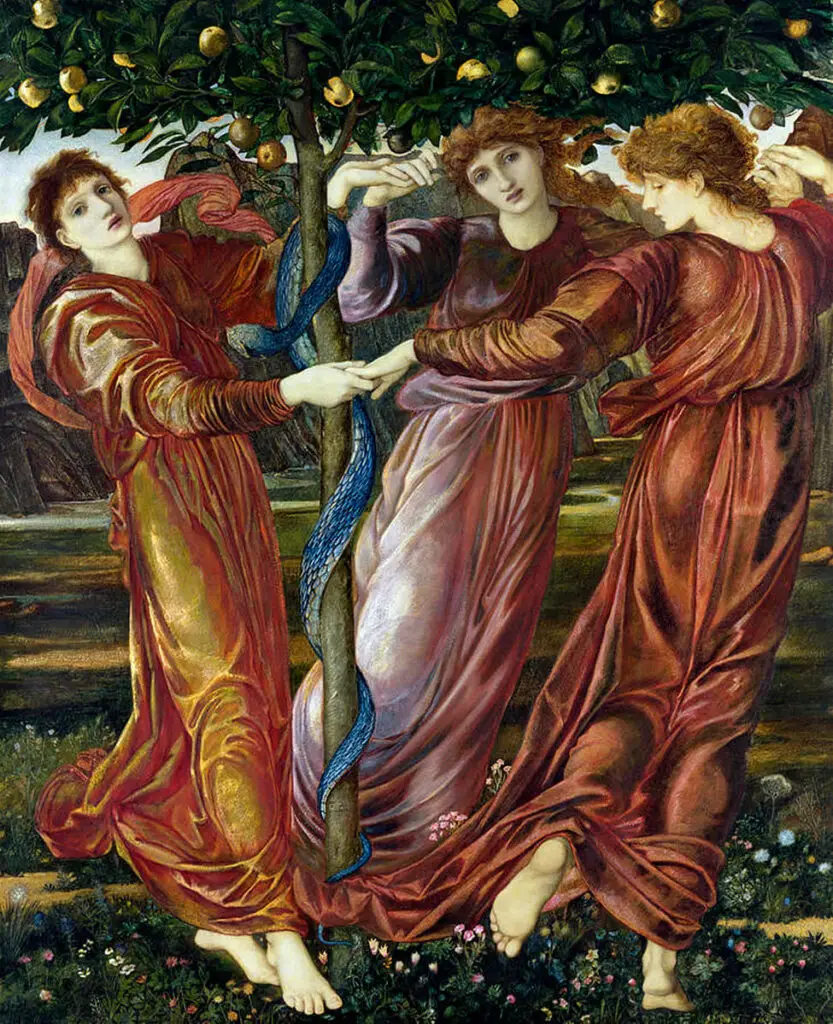
The painting, completed circa early 1870s watercolor on paper on canvas although WikiMedia says it’s oil on canvas. It measures 1190 x 980 mm (46.85 x 38.58 in). It measures 120cm x 140.5cm (47.24 x 55.31 in) framed. The Hamburger Kunsthalle currently owns the painting. Strangely, I couldn’t find it in the “regular” collection. I did find it in their online collection (using the German spelling). That leads me to believe it is not currently on display. To further confuse matters, I found another citing saying the painting is in a private collection. I have no clue, my friends. Perhaps, Shelbee, who has super sleuthing powers, will find something more clarifying.
My interpretation…
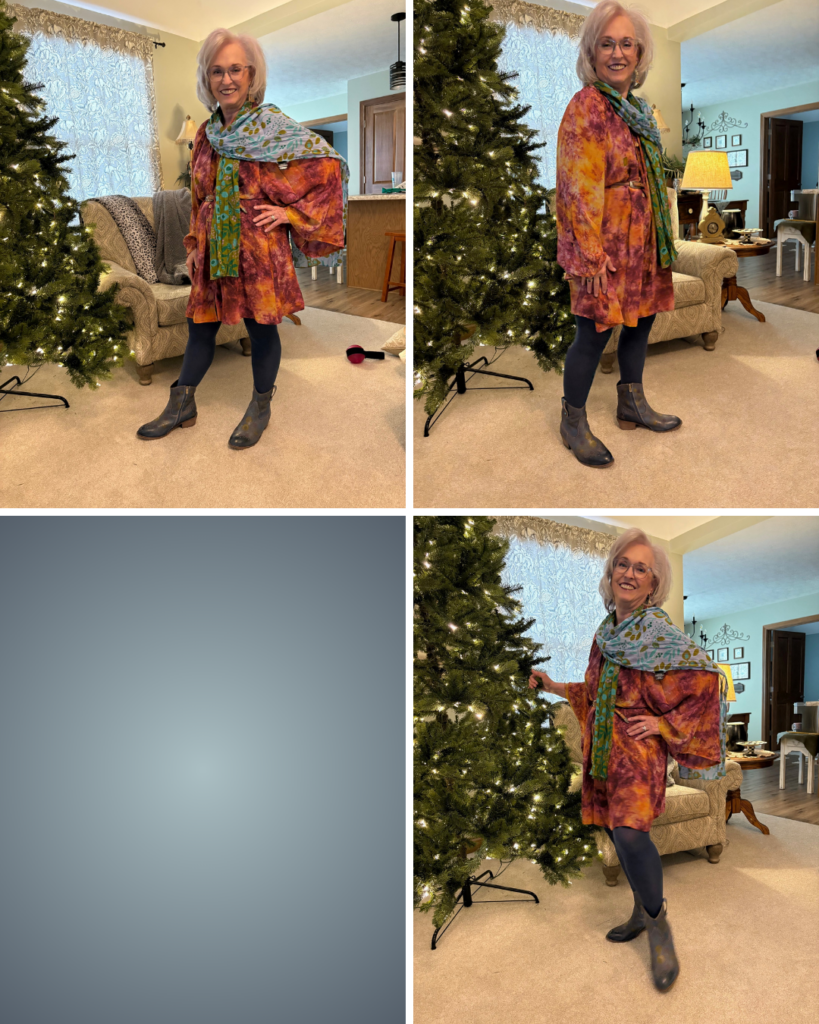
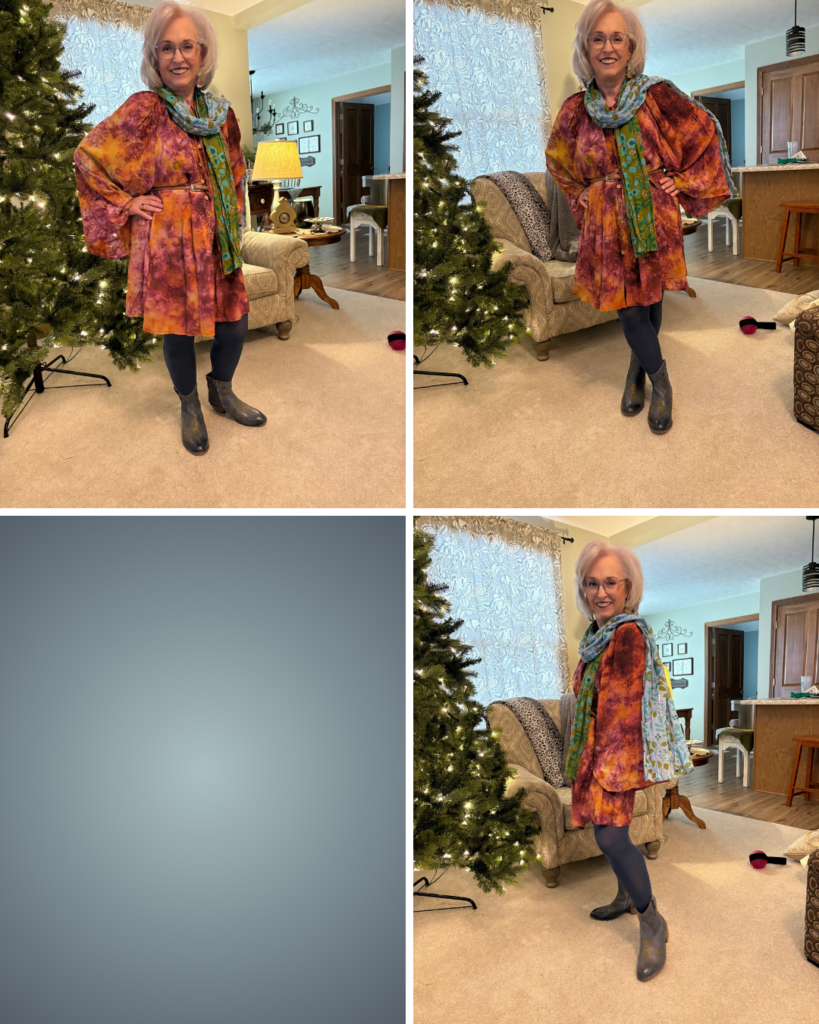
This is a stretch, I know! I had thought to wear an April Cornell dress in brown with lots of beautiful roses on it. But, as always seems to happen, when I looked again at the painting, I realized the Hesperides were wearing garments lacking a print. So, that sent me back to the closet with just the colors of the dresses in mind. And, that, my friends, is how I ended up in this Kantha Bae Woodstock Shortie Kimono. I thought the colors in this tie-dyed kimono were a pretty good representation of the three dresses. Then, I added blue tights and a blue and green Sally shawl from Gudrun Sjödén to represent the snake. I belted the kimono because it’s rather shapeless. In the future, I will probably wear it open over jeans and such.

The Lewk!
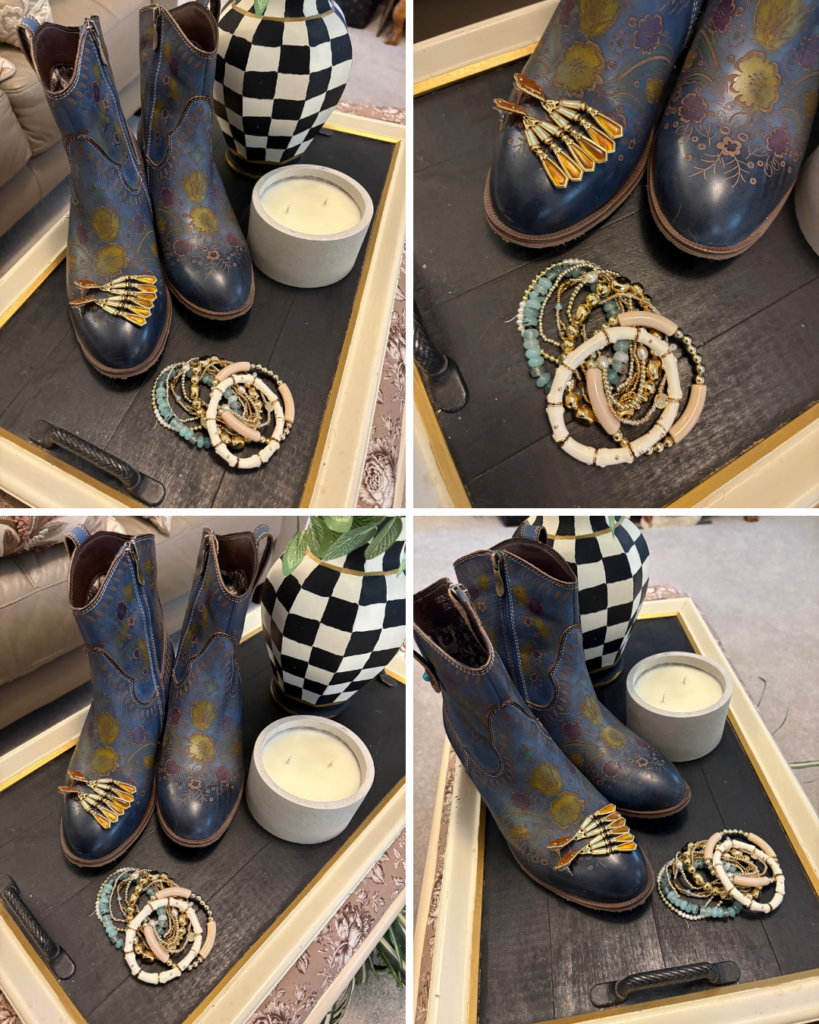
I was already planning to wear these Galop Boots by L’Artiste. What I wasn’t prepared for was for them to so closely match my tights! I then added a mixture of gold bracelets from several different places. I think some are from World Finds. A couple I bought at Talbots. I don’t really know where that green beaded one came from, though. The pièce de résistance are my earrings, I think. I really love these, but I forget to wear them. They are from Kendra Scott, but I can’t find them on the website so they must be sold out.
Wrap it up, Marsha!
Whew! That was a lot, wasn’t it? I hadn’t ever heard of this artist. Every time, I hope it’s someone with a very short biography, but it rarely is. I love learning, though! I’m still not 100% clear on what the Pre-Raphaelites were. I do think they would have disliked my beloved Bouguereau immensely! So, can we talk? Have you ever heard of Pre-Raphaelites? Is there an easier way to describe them? How would you have interpreted this piece? Please leave me a comment or two, and we can talk. I promise to respond as quickly as I can.
Don’t forget…
If you want to be included in the Style Imitating Art round up, send Salazar your photo by 10:00 pm EST, Tuesday, February 10th. Photos of everyone participating will appear on her blog on Wednesday, February 11th! If you’re interested in joining us, consider all of your options…the colors, the textures, the feelings they evoke! Come on, give it a try! I think you’ll love it!
Thank you!
I want to thank all of you from the bottom of my heart for reading, commenting, subscribing or emailing! It truly means so much to me! If you’d like to follow me on Instagram, you can find me here.
Affiliate links, discount codes, and such:
Just a reminder that Marsha in the Middle may use an affiliate link. Those links are usually italicized. If you click or make a purchase from an italicized link I provide, I may receive a small commission at no cost to you. Thank you for your support. My April Cornell code, MARSHA15, now works, but it’s good for only one use. You can get $15 off $100. I’d wait and use it during a really good sale! Use Marsha12 for 12% off any order of $65 or more at Buykud. I have also become a Halftee Partner. Use the code, MARSHA2098, for 20% off any purchase. I am also an affiliate with Clara Sunwoo. You can use my code, MARSHA10, for 10% off your entire order. Use MARSHA15 at Katia Designs for 15% off your order. In case you didn’t know, bloggers must disclose the use of affiliate links. That’s why I include this in each post.
Where you can find me:
Linking up with Nancy’s Fashion Style, Fine-Whatever, Is This Mutton, Shelbee on the Edge, Chez Mireile, Suzy Turner, and Away from the Blue as well as Deb’s World . I also link up with This Blonde’s Shopping Bag, Doused in Pink, I do deClaire, Mummabstylish, Style Splash and Elegantly Dressed and Stylish as well as the Senior Salon Pit Stop (Esme’s Salon) and Slices of Life. Please check out these wonderful ladies and their blogs! I also am a co-host for Ageless Style on the third Thursday of the month and Songful Style on the last Monday of the month. I co-host Traffic Jam Weekend every Thursday with Melynda, Lisa, and Sue. I also host 10 on the 10th on the 10th of the month! I do hope you’ll check out all of these blogs and link parties!
Oh Marsha, your face! You don’t look happy. Thank you for sharing, anyway, it’s perfect!
As is your outfit, the color works so beautifully for the painting.
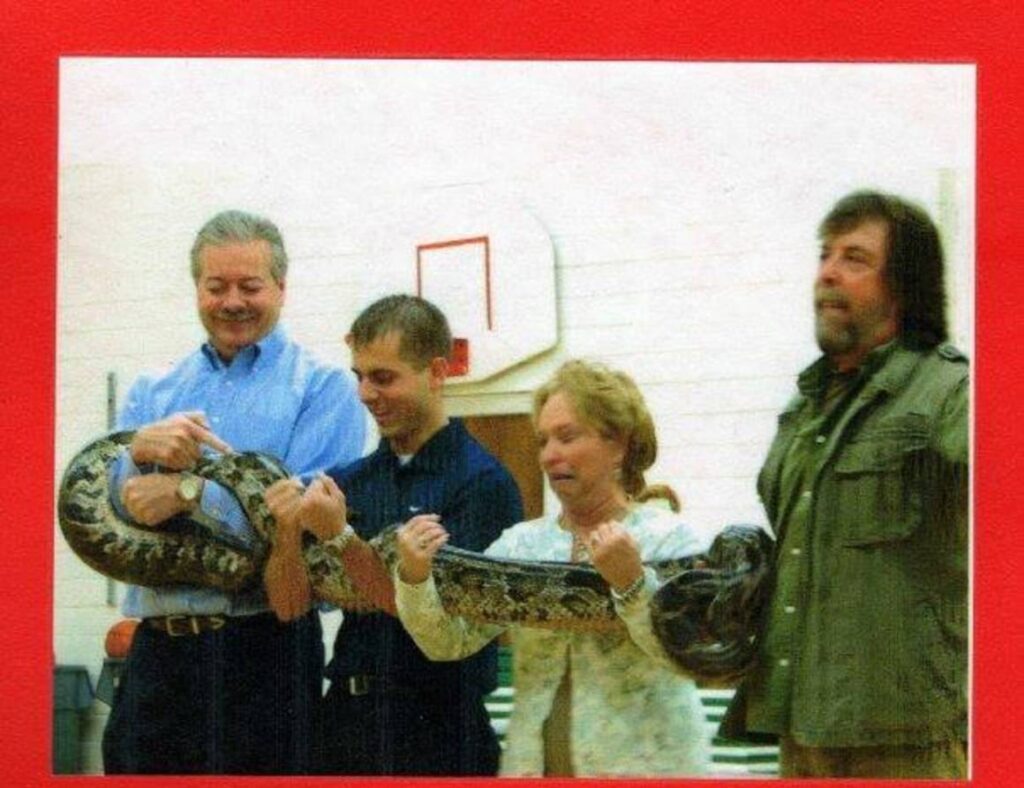
Thanks, Cat! Larry, the guy with the snake, did this every year. He’d call for a kid or a teacher to come down. This was the year I retired so all my kids and former kids yelled out my name. I couldn’t refuse, but you can definitely tell I wasn’t thrilled about it! I’m so glad you like the outfit!
Interesting story. I think I remember that one of his works played a role in a English detective. You interpreted it very well! I can imagine that scarf is a snake! Lol.
Thanks, Nancy! It could be. He produced lots of works. I’m glad the scarf as snake came through!
Thank you Marsha and the photo with the snake tells it all.
Thanks, Rosie! That snake was huge, and I just wanted to make sure I didn’t faint or vomit. They look like they’re still, but the insides of them are always twisting around. It’s a very weird feeling.
I absolutely adored the pre-Raphaelites and had many of their prints adorning the walls of my various rented flats. The movement is now considered rather overly romantic and not the best kind of art, and I too have moved away from my initial deep love for them. But I still think they were a force to reckon with and that their painting while ‘romantic’ as very worthy of a good look at a certain kind of art. Basically they gave us very pretty paintings and sometimes that’s all we need.
Love the colours of your kimono, I’d wear it if it was twice as long!
Thanks, Penny! I didn’t really know who the Pre-Raphaelites were, but I did recognize the art style. I can see why people would say it wasn’t great art when compared to what was before and what came after. But, I love it. In today’s world, I’ll definitely take pretty paintings! I have one of these that is long. The funny thing is the shoulders are more pronounced. They look like church choir robes!
I am not a fan of snakes either but they are in a whole lot of works of art. You did a great job with your outfit! Those colors fit the painting perfectly.
Thank you, Joanne! I prefer scarves to snakes, that’s for sure!
Love it.
Thanks so much, Emily!
Pingback:Style Imitating Art | “The Garden of the Hesperides” by Edward Burne-Jones – Shelbee on the Edge
Kantha Bae to the rescue! I also styled a Kantha Bae robe because the colors and prints were pretty spot on for this paining. I love this short tie dye kimono and those boots are just magnificent! What a fabulous interpretation of the artwork while remaining true to your wonderful bohemian style. I love it all! Sadly, my sleuthing powers failed on this one. I actually referred my readers to your post because I didn’t have time to cover the career of the artist in my post. Sometimes these very long bios overwhelm me to the point that I just link instead of writing it all out! Well done as usual, my friend!
Shelbee
Thanks, Shelbee! I saw your outfit and loved it. It seems like I either use Kantha Bae or April Cornell! I like the short version of this kimono better than the longer ones. They almost look like church choir robes! I read it was at that one gallery, but it only shows up online. It’s weird. I’m guessing it’s in a private collection.
The colors!! Just so perfect, and it goes to show that a contrasting scarf can be a fabulous thing.
XOOX
Jodie
Thanks, Jodie! I love wearing a scarf that’s different in color. But, I was also using it as the snake.
I like the way you wrapped the scarf around your neck – that’s about as close to a snake around my neck as I’d ever like to get! Nice job, Marsha, you are so creative!
xo,
Kellyann
Thanks, Kellyann! That would, normally, be the closest I want to be to a snake, but I’ve already been closer! I’m so glad I didn’t faint and traumatize the little kids!
This look is a wonderful representation of this art! The added scarf is perfect. That pic of you and the snake is crazy. Yikes!
https://www.kathrineeldridge.com
Thanks, Kathrine! I really was pleased with the kimono and the scarf as the snake. Yep, I got that photo and laminated it just so I’d never lose it!
I think you did a fantastic job! The kimono is the perfect shade of brown! And your scarf works well to represent the snake! That is QUITE the snack you held! Oh my!
Thanks, Laura! I was sure the nymphs’ dresses were patterned, but they weren’t. I thought the kimono did a good job of combining all the dresses. Yes, that snake was huge! And, I was afraid I was going to faint or vomit. Luckily, Larry, the guy who had the snake, kept the head away from me!
Pingback:SIA: The Garden Of The Hesperides | 14 Shades Of Grey
The colors of your kimono are beautiful and perfect for this piece of art! And yikes! That’s a big snake!
Jill – Doused in Pink
Thank you, Jill! Yes, that snake was huge and heavy! They don’t look like they’re moving, but the inside is. I was afraid I was going to either faint or vomit, and the kindergarteners were right there. I just knew I had to hold it together!
Pingback:Style Imitating Art: Frida Kahlo and Her Pet Deer Grazio - Marsha in the Middle