

Style Imitating Art…
Welcome back for my interpretation of a beautiful piece of art on paper. Salazar, Shelbee, and I are the curators. You can think of this series as fashion meets art museum! SIA challenges people to find inspiration in different art works, create looks based upon that art work, and share them with the curator for that piece. I chose this beautiful painting from the 17th century for us. I hope you enjoy this post, the information, and my interpretation.
How it works…
Every other Monday one of us selects an inspiration piece of art and posts the image on their blog. We then invite others to interpret that art work through their style. The following Monday, we share our outfits. The curator shares submissions the following Wednesday on her blog. I chose this week’s art work for this round of Style Imitating Art. If you’d like, you can read why I chose it here. Please send your photo to me by Tuesday, September 22nd, 2026 by 10 pm EST. Style Imitating Art is an interesting way to inspire your outfits. You can see a few of my looks here, here, here, and here.
The artist…
Deemed the “Master of Light,” Johannes Vermeer (also known as Jan Vermeer) was born on October 31, 1632. Until his later years, we aren’t talking about a starving artist today! Vermeer was born in Delft, in The Netherlands. His father, Reijnier Janszoon, was a middle-class weaver of silk or caffa (a mixture of silk and cotton or wool), and innkeeper as well as an art dealer. His mother, Digna Baltus, signed an “x” on her marriage certificate which led many to believe she was illiterate. Her father, Balthasar Geerts (or Gerrits) was a metalworker and was arrested for counterfeiting. In 1625, Vermeer’s father shot and killed a soldier, Willem van Blylandt (he died five months after the brawl). Reijnier was convicted and acquitted of manslaughter. It’s been suggested he was acquitted because of the familiarity between Reijnier and the master painter of the Guild of St. Luke. He began dealing in art around that same time. By 1631, he had acquired enough wealth to lease an inn, “The Flying Fox.” By 1641, Reijnier had moved to a larger inn on the market square and called it the Mechelen which may not have been the best financial decision for the family. Around 1640, he changed the family surname to Vermeer though no one knows why. When he died in October 1652, Johannes took over the running of the family’s art business as well as the inn.

Early life…
Not much is known about Vermeer’s early life. We do know he was baptized at the Nieuwe Kerk (“New Church”) and given the name of Joannis which was a Latin form of Jan. Vermeer never used either name. His parents were not Catholics, but they were close to being upper-middle class Protestants. Jan was the preferred version of Joannis by Calvinists. Although Vermeer was initially a Protestant, he converted to Catholicism when he married Catherina Bolnes from the Papenhoek, or Papist’s Corner of Delft. The young couple would eventually move in with her mother, Maria Thins, a distant relative to the Utrecht painter, Abraham Bloemaert.

Possible training…
We don’t know much about Vermeer’s early art career. His name is matched with many different artists of the Dutch Golden Age, but none are actually listed as his teacher. In fact, his name isn’t even mentioned in the Delft archival records during the late 1640s and early 1650s. Some think he may have traveled to Italy, France, or Flanders as many young Dutch artists did. He may also have traveled to Amsterdam or Utrecht for training. He definitely was influenced by the works of Caravaggio, Gerrit van Honthorst as well as Rembrandt van Rijn, fellow Dutch Master. Others considered as possible mentors include Leonard Bramer, Carel Fabritius (a former Rembrandt pupil), Gerard Terborch (an artist also known for painting everyday life), and Pieter de Hooch. Like Vermeer, de Hooch used perspective, creating light-filled interiors. Another interesting possibility is Abraham Bloemaert, a relative of his mother-in-law. Vermeer registered as a master painter in the Delft Guild of Saint Luke on December 29, 1653.

Painting style…
Early in his career, Vermeer painted as most did back then. He painted religious or mythological scenes. These were done with a heavy hand, “monochrome shades of grey (‘grisaille’) or a limited palette of browns and greys (‘dead coloring’), over which he would apply more saturated colors (reds, yellows, and blues) in the form of transparent glazes.” As his artistry matured, Vermeer began painting the everyday scenes for which he would much, much later become famous. He painted two cityscapes and two allegories. But, overall, “his subjects offer a cross-section of seventeenth-century Dutch society, ranging from the portrayal of a simple milkmaid at work, to the luxury and splendour of rich notables and merchantmen in their roomy houses.”

Pigments…
Although the Vermeers were comfortable, probably due to the largesse of his mother-in-law, Vermeer never became wealthy. Perhaps one of the reasons was his use of expensive pigments. He is best known for using ultramarine, lead-tin-yellow, madder lake, and vermillion. Only about 20 pigments have been found in his work. Of these, the most used were lead white, yellow ochre, vermillion, madder lake, green earth, raw umber, and ivory or bone black. Even as his financial problems grew, Vermeer continued to use his beloved ultramarine (derived from natural lapis lazuli). He used these early in his career and also quite lavishly throughout his career. He not only used it naturally, but Vermeer also used it beneath layers of earthy colors to “subtly tint their shade.” In the painting, The Girl with the Wine Glass, Vermeer painted the underlying layer with natural ultramarine, then layered a red lake and vermillion mixture over it. This gave the dress a “slightly purple, cool and crisp appearance.” One thing to note is that Vermeer didn’t just toodle on down to the local paint store to buy a tube of his favorite colors. These pigments had to be ground and turned, eventually, into a medium with which he could paint. It’s also believed Vermeer may have had a patron who would buy the expensive pigments for him.
“Primarily, Johannes Vermeer focused on realistic subjects, as evident in most of his paintings. It is also worth noting that there is nothing extraordinary with the way he interpreted his subjects. Nevertheless, Vermeer’s artworks were all rather spectacular and enigmatic. Unlike other artists, he was not focused on making self-portraits. Rather, he was much more interested on painting objects and scenery that allowed viewers to contemplate of these. There was also a lack of any narratives in any of his works since his main purpose was to give people that opportunity to focus on the present moment and let a story evolve in the mind of the viewer.”

Luminosity…
As Vermeer captured scenes of domestic tranquility, he used “perspective and the placement of individual objects – chairs, tables, walls, maps, window frames – to create a sense of nature’s underlying order. Vermeer’s carefully chosen objects are never placed randomly; their positions, proportions, colors, and textures work in concert with his figures. Radiant light plays across these images, further binding the elements together.” Our eyes are drawn into the painting as we gaze upon the figures living their peaceful and tranquil lives. Vermeer created many of his greatest paintings in the course of about one decade. “No other contemporary Dutch artist created scenes with such luminosity or purity of color, and no other painter’s work was infused with a comparable sense of timelessness and human dignity.” Vermeer became known for these paintings of 17th century Dutch society just as van Gogh had his sunflowers, Cezanne his apples, and Monet his water lilies. What shown, quite literally, from his paintings, was the luminosity of the paintings. Another hallmark of a Vermeer paintings was the appearance of a painting within a painting.

Camera obscura…
One of the arguments posed about Vermeer’s use of light is whether or not he used a camera obscura. Now, I’m not going to even try to explain what that is other than to say it was some kind of box with a lens and mirrors inside it. It would project an image onto something and “gave the artist a better concept of the depth of these elements on the surface of the subject.” Some argue this is very evident in The Lacemaker and Girl with the Red Hat. Others contend he created this effect by his genius with pigments and brushstrokes. In any event, the lines he achieves in these paintings (and others) are crisp and appear almost photographic. You can read more about camera obscura here and here.

Later years…
Over the years, Vermeer was named the headman of the Guild of Saint Luke four times, 1662, 1663, 1670, and 1671. Although he painted for a couple of decades, Vermeer’s output seems to be limited to 34 to 37 pieces. Others dispute that, claiming other pieces have been misattributed to others. Over the two decades or so he painted, Jacob Dissius, a Delft collector, bought no fewer than 21 of them. That may account for why Vermeer’s work wasn’t well known during his life. No known commissions exist, but Vermeer was renowned in Delft. He asked for and received high prices for his work. In 1672, French troops invaded The Netherlands. This led to a collapse of the economy in Holland. Vermeer had never been well off…just comfortable. After this, Vermeer, in order to support his wife and eleven children, was forced to ask for loans from friends and others. One painting, The Art of Painting, was so valuable to the family that they refused to sell it even as they grew more and more destitute.

Death…
Vermeer died on December 15, 1675 and was buried on the same day in the Oude Kerk (Old Church) family crypt. His wife, Catharina, in petitioning his creditors wrote his death was due to the stress of financial pressures and described his death here:
“… during the ruinous war with France he not only was unable to sell any of his art but also, to his great detriment, was left sitting with the paintings of other masters that he was dealing in. As a result and owing to the great burden of his children having no means of his own, he lapsed into such decay and decadence, which he had so taken to heart that, as if he had fallen into a frenzy, in a day and a half he went from being healthy to being dead.”

Debt and legacy…
She claimed the collapse of the art market destroyed her husband’s business both as an artist and an art dealer. She then asked the High Court to release her of the debts Vermeer owed. Antonie van Leeuwenhoek, the Dutch microbiologist and microscopist, was appointed the trustee. The Vermeer home had eight rooms, inventoried a few months after Vermeer died. His studio contained two chairs, two painter’s easels, three palettes, 10 canvases, a desk, an oak pull table, a small wooden cupboard with drawers, and “rummage not worthy being itemized.” Of Vermeer’s paintings, 19 were bequeathed to Catharina and her mother. Catharina sold two of the paintings to pay off a substantial debt. Vermeer more or less disappeared from the art world until German art historian, Gustav Friedrich Waagen, and French journalist and art critic, Théophile Thoré-Bürger brought Vermeer and his masterpieces to the forefront once again. Vermeer is now considered one of the three greatest Dutch painters, along with Rembrandt and van Gogh.

The artwork…
The Concert measures 28.5 by 25.5 in (72.5 by 64.7 cm) and is oil on canvas. It is believed to have been painted sometime between 1663-1666. At an 1892 Paris auction, Isabella Stewart Gardner bought it for $5,000. That would be $183,471.43 today! This was Gardner’s first purchase without the help of others. It was purchased from the estate of Théophile Thoré (1807–1869), a prominent critic. He was “instrumental in reviving the reputation of Vermeer.” What makes this painting even more fascinating is its history. On March 18, 1990, two thieves, disguised as policemen, handcuffed one of the guards, then bound both guards and placed them in the basement. For 81 minutes, the two thieves used box cutters to remove several different paintings from their frames. They bypassed more valuable paintings for less valuable ones. This leads me to believe the duo had a list of pieces to nab! The video I’ve linked of a CBS piece on “Sunday Morning” says the pieces are probably in an attic or basement. I disagree. I think they are in the vaults, hidden rooms, or collections of rich people. In any event, the thieves stole 13 works form the museum, none of which has been seen since that day. It’s interesting they picked the morning of March 18th if you think about it. The early morning right after St. Patrick’s Day? Hmmm… Right now, the painting is considered the most valuable stolen work…that value is $250 million! The museum, under the dictums of Gardner’s directive, still displays the frames in the places where they had previously hung.
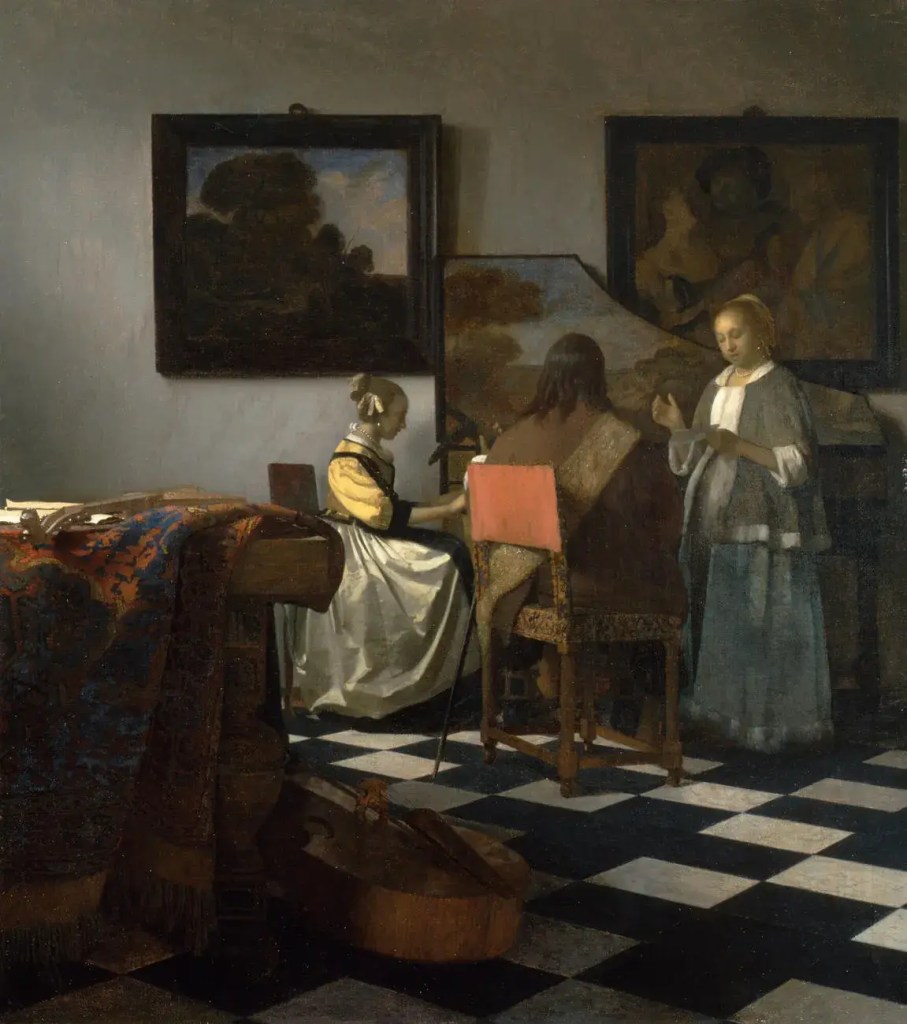
Here is a wonderful description of the painting:
“In a pristine domestic parlor, two women and a man concentrate on making music. The standing woman holds a sheet of music and raises her hand to beat time for her companions. Turned enigmatically away from our gaze, the seated gentleman wears an elaborate decorated sash that indicates his membership in a civic militia. Some scholars have been tempted to interpret Dutch musical scenes like this as moral warnings against seduction and illicit sex. Indeed, hanging on the wall at the right is a painting of a procuress by Dirck van Baburen. Although the subject of this painting-within-a-painting seems to suggest that something improper is taking place, the Procuress was in fact owned by Vermeer’s family. Moreover, the figures in the room are intently preoccupied with their music: they do not look at each other, and seem unaware they are being observed. Their intensity does not invite interruption. Lying on the large table at left is a lute, while a viola da gamba lies on the floor. Are these instruments soon to be taken up by the trio, or are others to join the group? Vermeer crafts rather deliberately a sense of mystery: this study in social interaction is a comedy of manners open to our interpretation. The mystery is intensified by Vermeer’s famed attention to the reflections of light. It sparkles off the women’s pearls (Mrs. Gardner’s favorite), the gold threads of the man’s sash, the white silk skirt, and even the Persian carpet heaped on the table. Isabella Stewart Gardner may have been drawn to the painting by its elegant depiction of the domestic music-making that she herself was so fond of.
Source: Alan Chong, “The Concert,” in Eye of the Beholder, edited by Alan Chong et al. (Boston: ISGM and Beacon Press, 2003): 149.”
Sources…
Gardnermuseum.org – the artwork
A fascinating interview that includes interviews with FBI agents, the museum director (2015), and possible places where the art is…
My interpretation…
Once again, I immediately thought I had the perfect dress for this art. Once again, I was completely wrong! Once I looked closely at the art, I noticed the woman standing on the right side of the painting and realized I had a skirt that was remarkably similar. But, I didn’t want to wear an artist’s smock like she is (thought I doubt she called it that). I did, however, have a yellow top and a couple of vests! I grabbed the skirt and top along with two vests. I took them out to show Nigel and ask his opinion. I could use a red one that would look a bit like the back of the guy’s chair, or I could use a blue one that would be an almost exact imitation of the woman’s look on the left. Well, obviously, you know which one I decided upon which is the one Nigel picked. I think the skirt is a Kantha Bae Wild Rose silk skirt, but they don’t seem to have any of those online anymore. The colors and the ruffle near the bottom seem perfect for The Concert. Next up was the top. Now, let me tell you about this top. As many of you know I’ve been shopping J Jill for decades (gah…how can that be). I bought this when we still lived up north, and I was still teaching. That means it has to be at least 13 years old. I would venture to guess it’s closer to 15-20 years old. And, that, my friends, is why I don’t get rid of clothing hippety hoppety! The vest is from last fall and is Gudrun Sjödén. All in all, I think I hit the mark quite well with this look!

The Lewk!

I had no idea what kind of footwear these women would be wearing. My guess would be (and I’m too lazy to google it) they wore some kind of leather boots. And, given it’s Vermeer, maybe their accessories were pearls (bonus points if you get the reference). Instead I leaned into the colors and came up with this! These are some L’Artiste sandals I bought a couple of years ago and haven’t worn much. Those flowers kinda dig into the top of my feet. I just need to put some moleskin there, and they’ll be fine. I also went ahead and added a bunch of earth toned wooden bead bracelets. The earrings? They may actually be older than my J Jill top! I bought those on clearance at Target back when it was the old store back behind Glenbrook…IYKYK!
Wrap it up, Marsha!
I just had to include one of the pieces from that James Lucas’ Substack post. Don’t be surprised if I pull another one from it because we need to see these pieces somewhere. It’s sad as well as terrible these paintings may never be seen again. I truly believe these paintings, with the exception of the van Gogh, are in someone’s private collections. So, can we talk? Where do you think this piece of art is? Do you think the guard was in on the robbery? Have you ever seen a Vermeer, and where did you see it? Please leave me a comment or two, and we can talk. I promise to respond as quickly as I can.
Don’t forget…
If you want to be included in the Style Imitating Art round up, send me your photo by 10:00 pm EST, Tuesday, September 22nd, 2026. Photos of everyone participating will appear on my blog on Wednesday, September 23rd! If you’re interested in joining us, consider all of your options…the colors, the textures, the feelings they evoke! Come on, give it a try! I think you’ll love it!
Thank you!
I want to thank all of you from the bottom of my heart for reading, commenting, subscribing or emailing! It truly means so much to me! If you’d like to follow me on Instagram, you can find me here.
Affiliate links, discount codes, and such:
Just a reminder that Marsha in the Middle may use an affiliate link. Those links are usually italicized. If you click or make a purchase from an italicized link I provide, I may receive a small commission at no cost to you. Thank you for your support. My April Cornell code, MARSHA15, now works, but it’s good for only one use. You can get $15 off $100. I’d wait and use it during a really good sale! Use Marsha12 for 12% off any order of $65 or more at Buykud. I have also become a Halftee Partner. Use the code, MARSHA15, for 20% off any purchase. I am also an affiliate with Clara Sunwoo. You can use my code, MARSHA10, for 10% off your entire order. Use MARSHA15 at Katia Designs for 15% off your order. In case you didn’t know, bloggers must disclose the use of affiliate links. That’s why I include this in each post. I have now have a code for Tulip Clothing. Use the code, MARSHA20, for 20% off your order.
Where you can find me:
Linking up with Nancy’s Fashion Style, Is This Mutton, and Shelbee on the Edge. I also link up with I do deClaire, Mummabstylish, and Style Splash as well as the Senior Salon Pit Stop and Slices of Life. Please check out these wonderful ladies and their blogs! I also am a co-host for Ageless Style on the third Thursday of the month and Songful Style on the last Monday of the month as well as the Global Writing Challenge on the second Thursday. I now co-host Fashion Files with Amy at Coffee and Cocktails at the Casa every Tuesday. I co-host Traffic Jam Weekend every Thursday with Melynda, Lisa, Cat, and Rena. I also host 10 on the 10th on the 10th of the month! I do hope you’ll check out all of these blogs and link parties!
Smart of you to mix the two ladies’ outfits for yours!
I have never seen a Vermeer myself, but I have read about some of his paintings. I also once saw a documentary about the use of light in old paintings (which also explained the camera obscura), it was fascinating.
Thank you Marsha. This made me think of The Vermeer Deception by Jennifer S. Alderson, a mystery set around one of the missing art pieces. I’ve also read Woman In Blue by Douglas Bruton which is an interpretation of Vermeer’s ‘Woman In Blue Reading A Letter’
I liked how you mixed inspiration from two of the ladies’ outfits to create your own look.
Very nice job with this look Marsha! I LOVE this hair – wow – what a flattering style on you!
xo,
Kellyann